The Last Mile Is the Whole Journey — What Seventy-One Farms Taught Me
Meghalaya imports 18,000 tonnes of pork a year while almost every household keeps pigs. The gap between those two facts is where Indian governance is actually decided.
What a backyard practice, turned into seventy-one working farms, taught me about the gap between what India announces and what reaches its people.
There is a sentence that explains most of what goes wrong in Indian governance: we have confused the announcement with the achievement.
A scheme is launched. A figure is read out — so many crores, so many beneficiaries, so many districts. The press release is filed, the ribbon is cut, and in the public mind the problem is now addressed. But a launched scheme and a changed life are not the same thing, and the distance between them is where governance actually lives. It is also where it most often dies.
Four findings anchor this analysis:
- Design is done at a distance from the place it lands. Schemes are conceived by people who will never meet the beneficiary. A backyard in the Garo Hills cannot be governed well from a desk that has never seen one.
- Incentives reward the launch, not the outcome. The official is rewarded for the disbursement and the count, not for the result two years later, which by then is someone else's posting. The system measures motion, not arrival.
- The yardstick is wrong by construction. We count crores spent, piglets distributed, candidates certified — because they are easy to count — and mistake them for impact, which is hard to count and is the only thing that matters.
- There is a vacuum where the last mile should be. Between the policy and the person stands a district administration, chronically under-resourced and over-loaded, expected to convert intention into reality with a fraction of the attention the intention received. When that link is strong, schemes work. When it is weak, the press release is all that survives.
The two failures of skilling
For two decades the dominant model of skilling India has been centralised and standardised: design national trades, build training centres, certify candidates, count the certificates. It is administratively tidy and politically legible, and it very often fails — because trades designed in a capital frequently have little to do with the talent, the markets or the lives of the people they are meant to serve. You can train a hill farmer as a certified retail associate, but if there is no retail and he has no wish to leave his land, you have produced a certificate, not a livelihood.
The instinct of the thoughtful person is to swing the other way: forget imported trades, build on native skill. But native skill is not automatically industry-fit either. A community can hold generations of accumulated capability and still be locked out of any real market, because that capability sits at a scale, a quality and a consistency the modern economy cannot absorb. Tradition, on its own, is not a livelihood. It is raw material.
The failure of centralised skilling is that it ignores what people have. The failure of pure traditionalism is that it overvalues it. The real work — slow, unglamorous, far from any stage — is in the narrow space between.
The pigs everyone already had
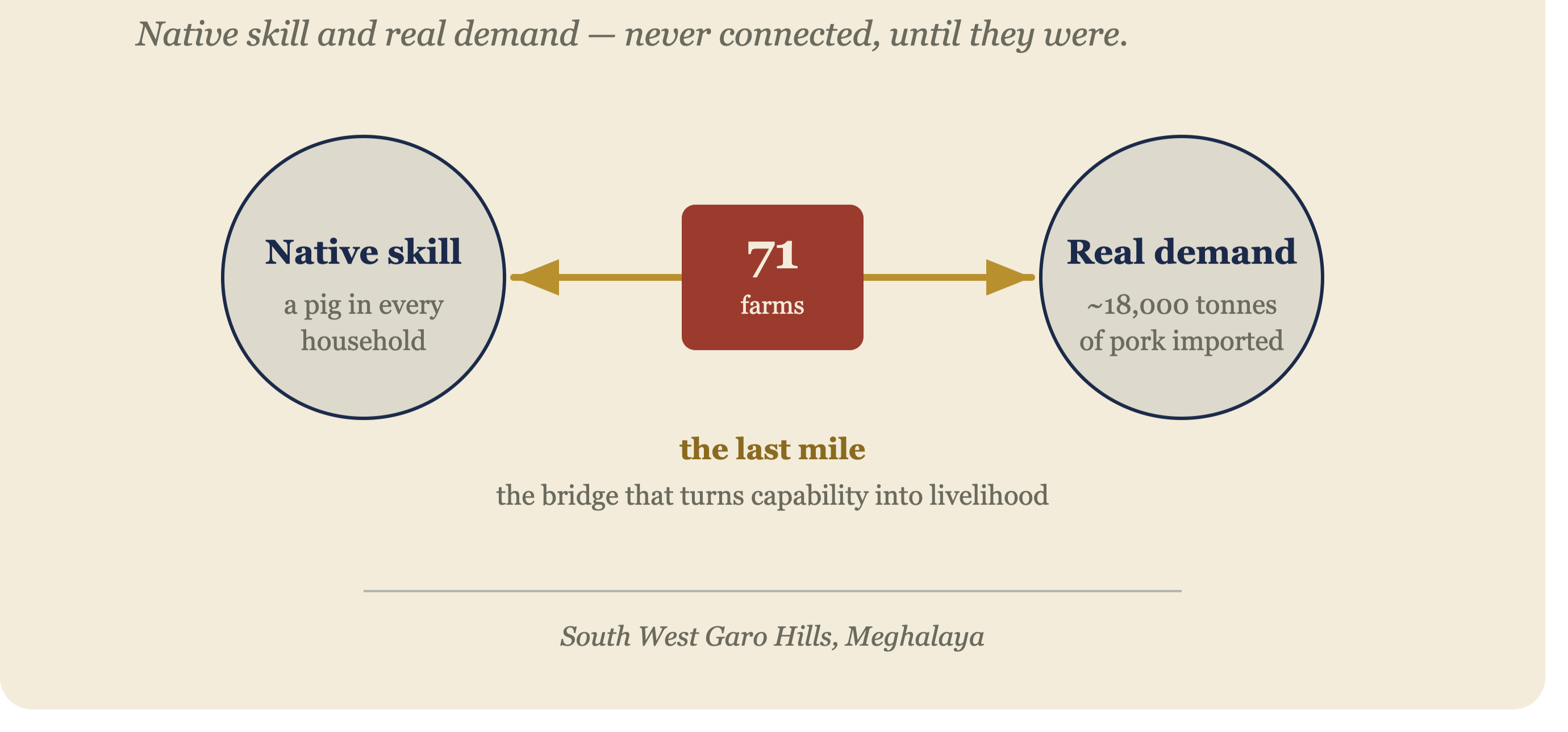
Almost every household in the Garo Hills keeps pigs. It is not a programme; it is a fact of life, woven into the rhythm of rural Meghalaya for as long as anyone can remember. The native skill was already there, in every home.
The demand was real too. Meghalaya does not produce enough pork to feed itself; the state imports roughly eighteen thousand tonnes a year from outside. Here was the rarest alignment in development work: a capability that already existed in the population, and a market that already existed in the economy, never connected at any meaningful scale.
Intent is not the hard part. A backyard with a pig is not a farm. Turning a household practice into an enterprise requires a hundred unglamorous things to go right in a specific place: siting and construction of proper sheds, breeding stock, feed supply, veterinary support, cooperative structures, a link to a buyer — and, above all, a district administration willing to make all of it happen on the ground rather than on paper.
In South West Garo Hills, in and around Ampati, that is the work I gave myself to. Working hand in hand with the district administration, we developed seventy-one piggery farms — not certificates, not enrolments, not a figure for a press release, but seventy-one functioning enterprises, each one a native skill finally fitted to a real market. We trained farmers in improved breeding and herd health, built the links connecting local producers to demand that already existed, and worked with local government to keep support flowing after the launch — the part that usually evaporates.
What the pigs teach about the state
I tell this story not because seventy-one farms will transform a state — they will not, on their own — but because they are a clean, small instance of a very large lesson.
Most of our public conversation is loud about who holds power and nearly silent about whether anything reaches the ground. We debate the cabinet and ignore the culvert. We treat the launch as the finish line. But the launch is the starting gun. Everything that determines whether a citizen's life actually changes happens afterward, in the part of the process that has no podium — where the design meets the district, where the scheme meets the household.
What we would do
Four disciplines convert a last mile from an afterthought into the design.
- Write the delivery chain before the scheme. Every step between sanction and household, with the officer responsible for each and the time it takes. Most schemes are designed with a budget and a target and no map of the route the money must travel.
- Measure at the household, not the treasury. One field-verified outcome per scheme, sampled independently, published. Disbursement data tells you the money left; it never tells you it arrived.
- Fund the middle. Where a capability already exists, training is rarely the constraint. Inputs, working capital, aggregation, quality consistency and a route to the buyer are — and they are usually unfundable under a skilling head. That is a drafting problem with an enormous cost.
- Hold the officer to the outcome, not the launch. Until some part of an official's record depends on what a scheme produced two years after they left the posting, the system will keep rewarding motion.
The journey from announcement to impact is not a straight line. The last mile is not the final step of governance; it is the place where governance is actually tested, and most of what we call policy failure is really last-mile failure wearing a different name. A rising India deserves to be judged not by what it announces, but by what reaches its last home.
Hear what the District Magistrate of South West Garo Hills says about this work: watch here.