The Certificate Is Not the Job — Why India Skills Millions and Employs Few
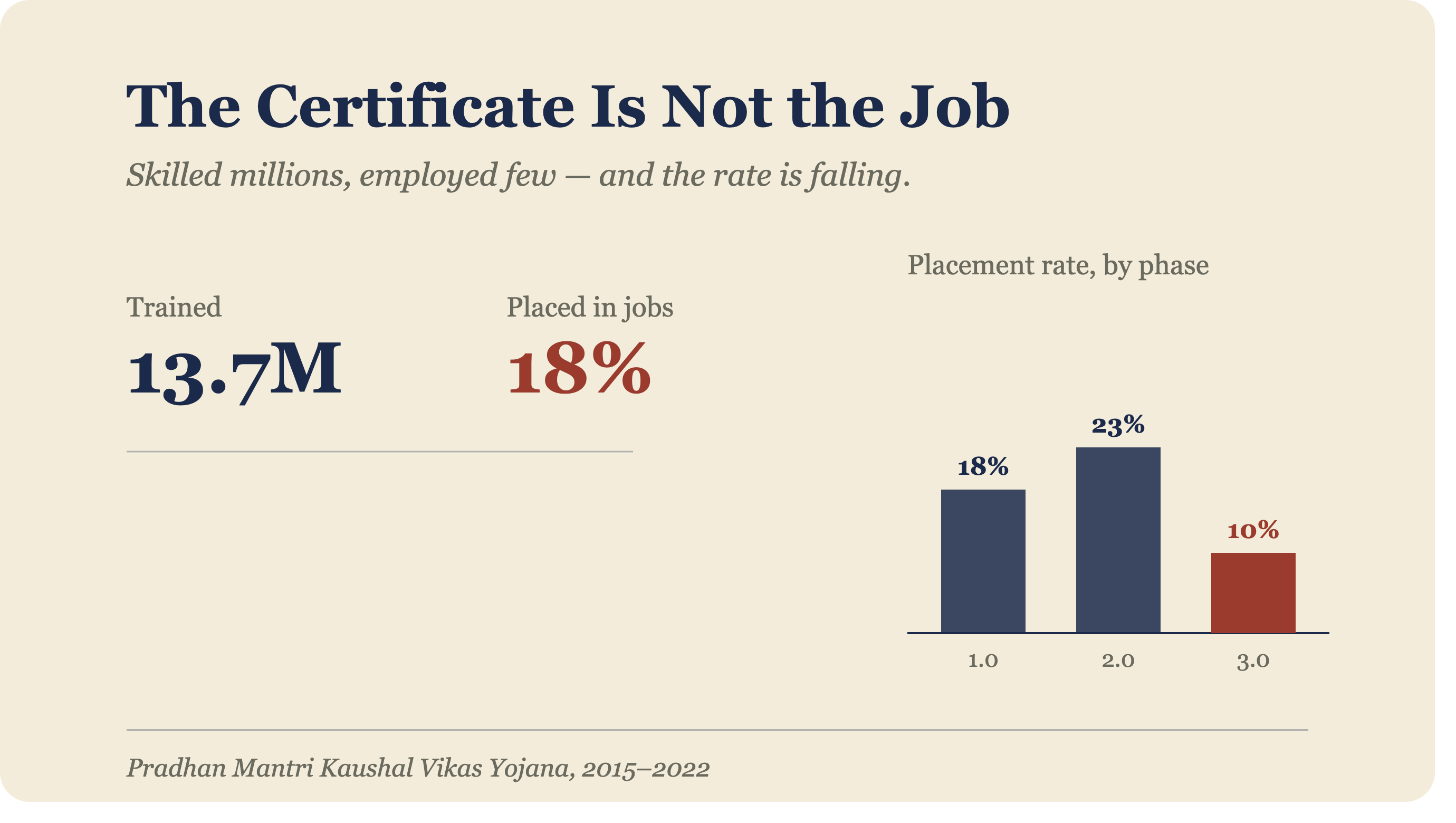
PMKVY trained 13.7 million people in seven years and placed 18 per cent of them. The failure is not effort; it is a system built to count certificates instead of livelihoods.
ProvenancePublished 25 June 2026; revised 31 August 2026 to add a provenance line. Placement rates across the scheme’s three phases, the divergence between reported and independently examined placement, the beneficiary survey that returned 171 usable responses, and the catalogue of deficiencies in training quality, certification credibility, placement outcomes and monitoring are from the Comptroller and Auditor General’s performance audit published in December 2025. Youth unemployment for Indians aged fifteen to twenty-nine is as commonly reported from the Periodic Labour Force Survey. The share of the current phase’s allocation spent by early 2026 is as reported. Data vintage note: placement rates across phases are computed by the scheme on its own definitions, which the audit questioned; the phase-to-phase comparison should therefore be read as a trend in the scheme’s own reporting, not as a verified outcome series.
India has skilled millions and employed few. The failure is not effort — it is that we built a system to count certificates instead of livelihoods.
In seven years to 2022, India's flagship skilling programme, the Pradhan Mantri Kaushal Vikas Yojana, trained 13.7 million people. It placed 18 per cent of them in jobs. Sit with that number, because it is the whole argument in miniature: thirteen million seven hundred thousand citizens were trained, certified, counted and announced, and roughly four in five walked away without the work it was meant to provide.
PMKVY did not fail for want of ambition or money. It failed because it was built to do the wrong thing well. It was built to count certificates, and certificates it produced.
Four findings anchor this analysis:
- The trend runs the wrong way. Placement stood at 18.4 per cent in the scheme's first phase, rose modestly to 23.4 per cent in the second, and collapsed to 10.1 per cent in the third. More money, more centres, more phases — and a smaller share of trainees ending in work.
- The system marks its own paper. In one accounting, the programme reported 54 per cent placement where independent examination found 22 per cent. The Comptroller and Auditor General, in a performance audit published in December 2025, catalogued deficiencies across training quality, certification credibility, placement outcomes and monitoring, and questioned whether the programme had ever genuinely been the "demand-driven" exercise it claimed to be.
- It cannot locate the people it has trained. When auditors attempted to survey the programme's own beneficiaries, the exercise returned 171 usable responses — many from the same email addresses, or from the training partners themselves. Identical photographs stood in for different "beneficiaries" across different states. A system that cannot find its beneficiaries is not measuring outcomes; it is performing them.
- The underlying problem has not moved, and the money is not flowing. Youth unemployment for Indians aged fifteen to twenty-nine sits near 15 per cent. The most recent phase of the scheme, by early 2026, had spent roughly 14 per cent of its allocation. The announcements continue; the arrival does not.
The trap has two jaws, and most reformers see only one
It is easy to read those numbers and conclude that the answer is better centralised training — sharper curricula, stricter audits, cleaner data. That is necessary, and it mistakes a symptom for the disease. The structural failure has two sides that the debate refuses to hold at once.
The first jaw is centralisation. Trades are designed far from where they are taught, for an economy that exists in the aggregate but not in the trainee's actual district. You can certify a young person in the Garo Hills as a retail associate, but if there is no retail within a day's travel and no wish to migrate, you have manufactured a certificate, not a future. The CAG's doubt about whether the programme was ever truly demand-driven is the audited form of a thing anyone who has worked in a village already knew: a skill the local market does not want is not a skill, economically speaking. It is a line item.
The second jaw is the romantic reflex against centralisation — the belief that the cure is simply to honour what people already know. There is real truth in it, and a quieter falsehood the romantics never quite face: native skill is not automatically industry-fit either. A community can hold generations of genuine capability and remain locked out of any market, because that capability sits at a scale, a quality and a consistency the modern economy cannot absorb. Tradition, by itself, is not a livelihood. It is raw material — valuable, but unfinished.
The centraliser fails by teaching skills no local market wants; the traditionalist fails by assuming local skill is enough as it stands. The space between them — narrow, unglamorous, place-specific — is where the actual work lives, and it is the space almost no programme is built to occupy, because it cannot be run from a dashboard.
Why the system optimises for the wrong number
Strip the problem to its mechanics and four failures recur — the same four that defeat delivery across Indian governance, not only in skilling.
It counts the wrong thing. Enrolments and certificates are easy to count, easy to announce and almost meaningless. Placement in decent-wage work is hard to count and is the only thing that matters. A system measured on the first will reliably produce the first.
It designs at a distance. Curricula are written by people who will never meet the trainee or the employer, for a national average that describes no real place. The market is local; the design is not.
It leaves industry off the table. With minimal private-sector involvement in design, training drifts out of step with what employers actually hire for. Outdated curricula meet shifting demand, and the trainee absorbs the mismatch.
Its feedback loop is broken at the root. A programme that returns 171 survey responses padded with duplicates cannot learn. It has no honest channel from outcome back to design — which is why the placement rate can fall for a decade without the model changing.
What works, and how I know
I know the alternative works because I have built a small version of it.
In the hills of Meghalaya, almost every household keeps pigs — a native capability present in nearly every home, in a state that imports some 18,000 tonnes of pork a year because it cannot meet its own demand. The skill existed. The market existed. They had never been connected at scale. The work I gave myself to, with the district administration in South West Garo Hills, was not to issue certificates. It was to build the specific, unglamorous bridge — sheds, breeding stock, feed, veterinary support, cooperative structure, a route to the buyer — that turns a backyard practice into an enterprise. Seventy-one farms, each one a native skill finally fitted to a real market.
No one in that work received a certificate. That was the point. The measure was not what we issued; it was what arrived — a household with an income it did not have before. Set seventy-one functioning enterprises against thirteen million certificates and an 18 per cent placement rate, and you have the entire difference between skilling that announces itself and skilling that reaches someone.
The counter-case, honestly stated
Three objections deserve a hearing.
First, the placement rate may measure something narrower than the argument requires. Placement tracking records entry into formal wage employment. It does not capture self-employment, family enterprise, or the upgrading of informal work that already occupies the great majority of Indian workers — including, as it happens, every one of the seventy-one pig farms described below. A trainee who returns to a family shop and runs it better is recorded as a failure. The 18 per cent is a real number about formal placement and a poor proxy for whether a livelihood improved, which means the indictment and the metric share the same defect.
Second, paying on placement will improve the average and may worsen the distribution. If a training partner's revenue depends on verified employment retained at six and twelve months, the rational partner stops training the marginal candidate and starts selecting the employable one — urban, better-schooled, already close to a labour market. The trainee in the Garo Hills is precisely the candidate an outcome-linked contract teaches a provider to avoid. Outcome financing and reaching the last home pull in opposite directions unless payment is explicitly risk-adjusted for candidate profile and location, and this analysis does not say so.
Third, the comparison at the heart of the essay is uneven. Setting seventy-one functioning enterprises against 13.7 million certificates scores a bespoke intervention and a mass programme on the same axis. The seventy-one required a district administration's sustained attention, a commodity with demonstrated local demand, and a founder physically present over time. Replicating that in every district requires the input the Review elsewhere identifies as the scarcest in Indian government — senior officer time in an office already carrying a dozen mandates. The method may well be right. Its constraint is not funding, and the essay does not price it.
None of this defends a placement rate that fell to 10.1 per cent, or an audit that found 171 usable responses padded with duplicates. It narrows the conclusion. The choice is not between mass skilling and place-specific enterprise building. It is to run both and stop reporting the first as though it were the second.
What we would do
The method scales; the project does not. Five changes would move a state skilling mission from certificates to livelihoods.
- Pay on placement, not on training. Shift a meaningful share of training-partner payment to verified employment retained at six and twelve months. Every failure catalogued by the CAG follows from paying for the input rather than the outcome.
- Verify outcomes independently, and publish them by centre. Third-party verification against employer records or provident fund registration, published at the level of the individual training centre. Placement claims that cannot survive publication are not data.
- Build the trade list from the district, not the state capital. A quarterly district-level demand assessment — which employers are hiring, for what, at what wage, within what travel distance — should determine which courses run. Courses with no local employer should not be funded.
- Fund the middle, not the classroom. Where a native capability already exists, the binding constraint is rarely training. It is inputs, working capital, aggregation, quality consistency and a route to the buyer. Those should be fundable line items in a skilling budget, and at present they largely are not.
- Put employers in the design room and make them sign. A curriculum co-signed by the firms expected to hire from it is a hiring commitment in embryo. One without such a signature is a guess about the labour market, written by people who do not participate in it.
India's demographic moment is real, and it is not permanent. A generation is passing through the years in which a skill well-fitted to a market compounds into a life, and we are handing too many of them a certificate instead. We measure our effort by what we announce: people trained, crores spent, targets set. The young person measures it by something simpler — can I earn a living, or can I not?
A nation is judged not by what it announces, but by what reaches its last home. The certificate is not the job. It never was.
Sources named in this essay
- Comptroller and Auditor General of India
- Ministry of Skill Development and Entrepreneurship
- Government of Meghalaya
Every figure in this essay is attributed in the text to the instrument and release that produced it. Links resolve to the publishing institution; the specific release is named inline.