The Arithmetic of Absence — Why Air India Is Losing a Market It Was Built to Lead
Air India's FY26 loss hit ₹22,238 crore as domestic share fell to 23.9%. A structured analysis of why the turnaround is stalling — and the correction required.
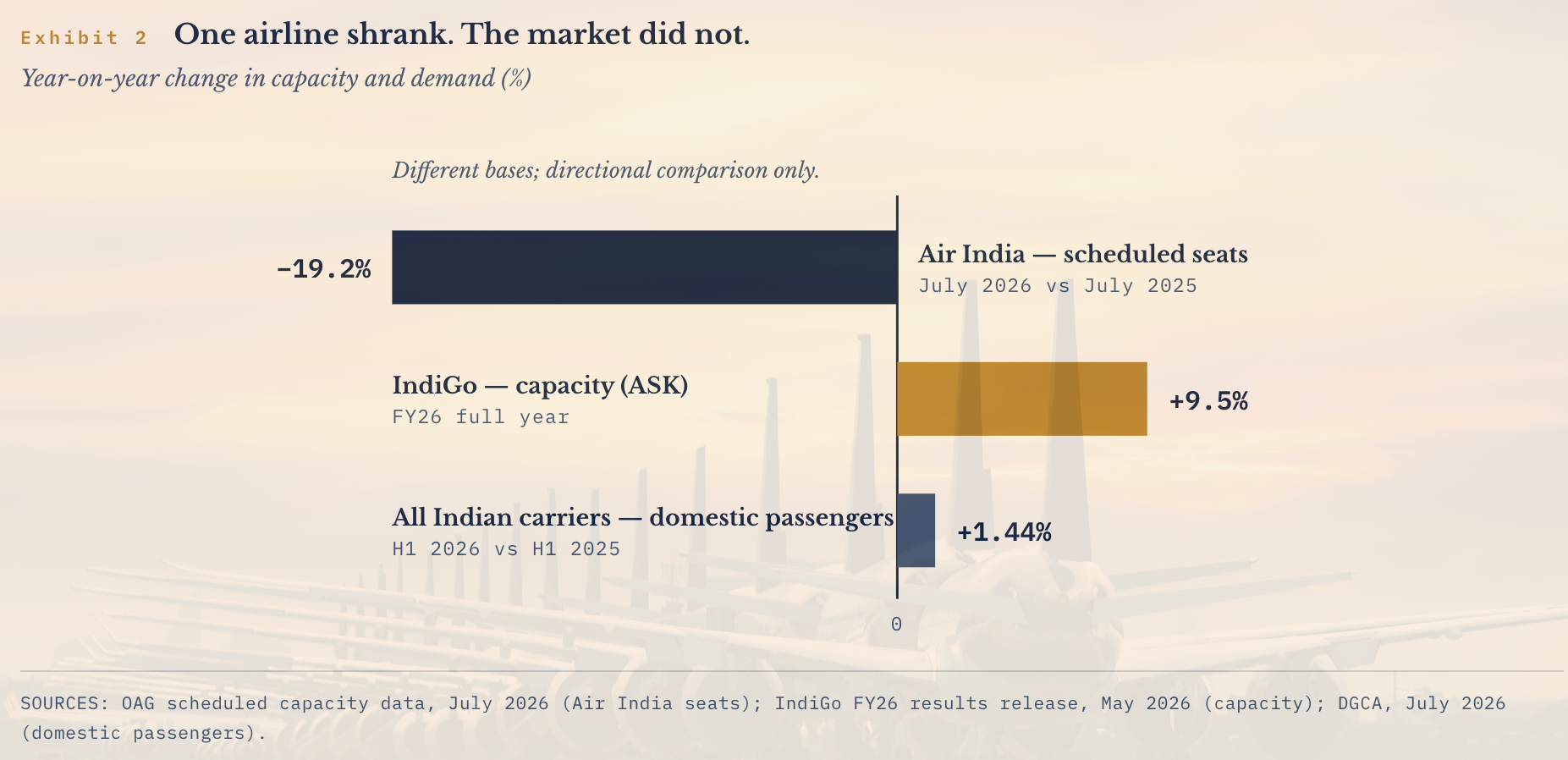
Air India is not losing its market to a better competitor. It withdrew capacity from a market that kept flying — and share in aviation is a residual of seats actually operated, not of strategy documents.
Air India is not losing India's aviation market because of its legacy, its ownership history, or a deficit of capital or ambition. It is losing because, across FY26, it withdrew capacity from a market that continued to fly — and market share in aviation is a residual of seats actually operated, not of strategy documents.
Five findings anchor this analysis:
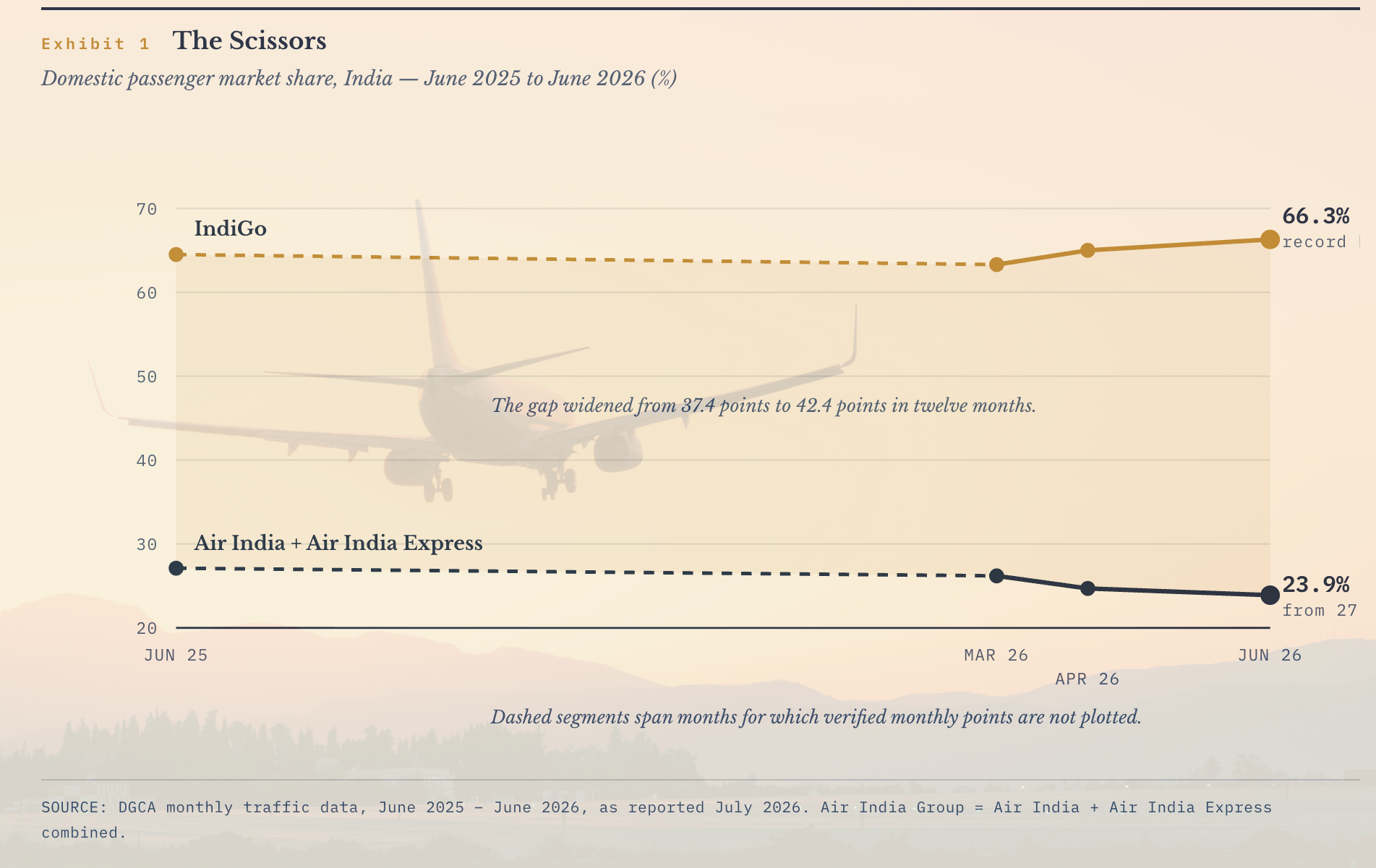
- The capacity contraction is the story. Air India's scheduled seat capacity in July 2026 was down 19.2% year-on-year (OAG). Its combined domestic share with Air India Express fell to 23.9% in June 2026 from 27.1% a year earlier, while IndiGo reached a record 66.3% (DGCA).
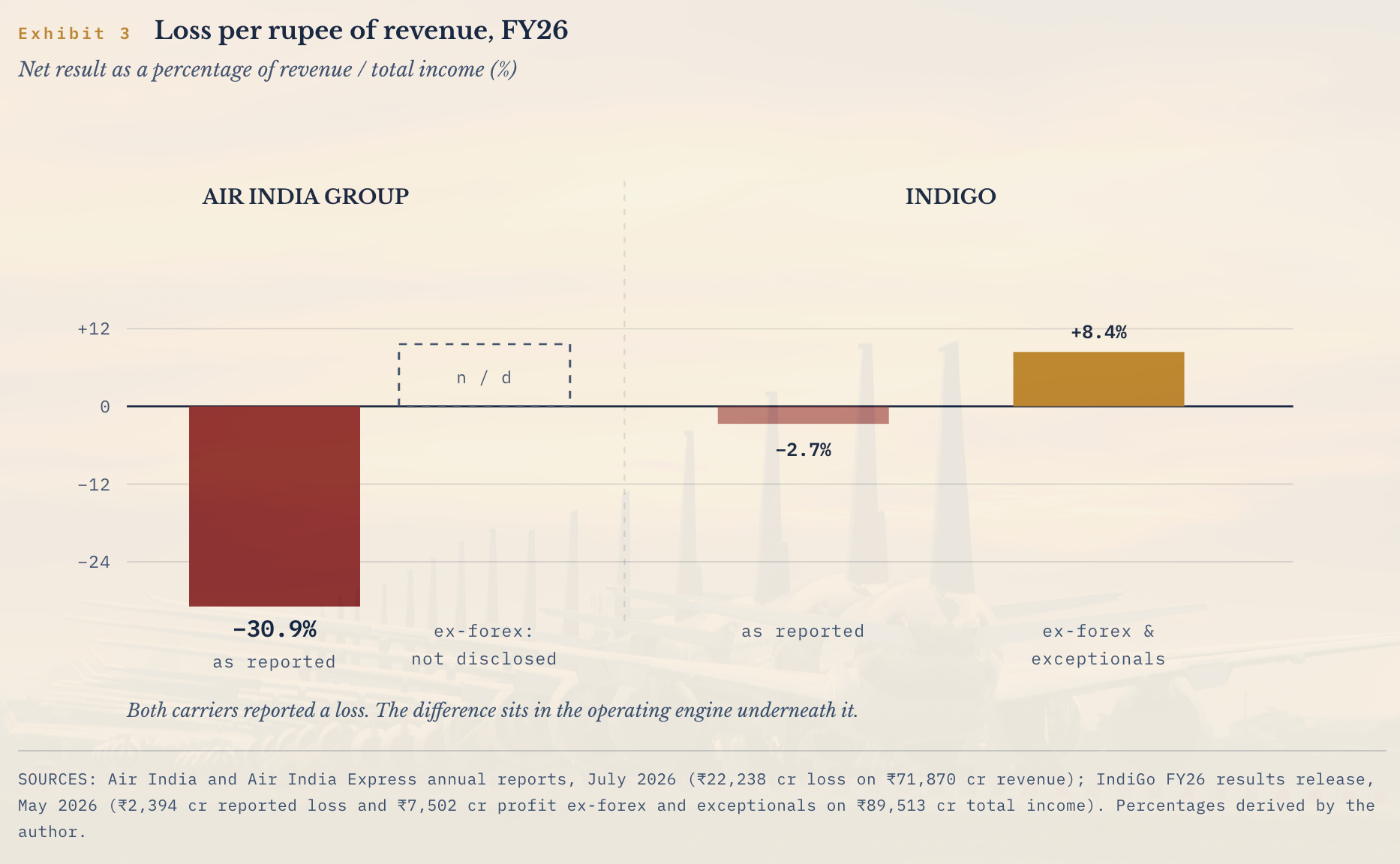
- The loss is structural, not cyclical. The Air India–Air India Express combine reported an FY26 net loss of ₹22,238 crore on revenue of ₹71,870 crore — a loss equal to roughly 31 paise for every rupee of revenue earned, against a comparable IndiGo operating result of approximately +8% ex-forex.
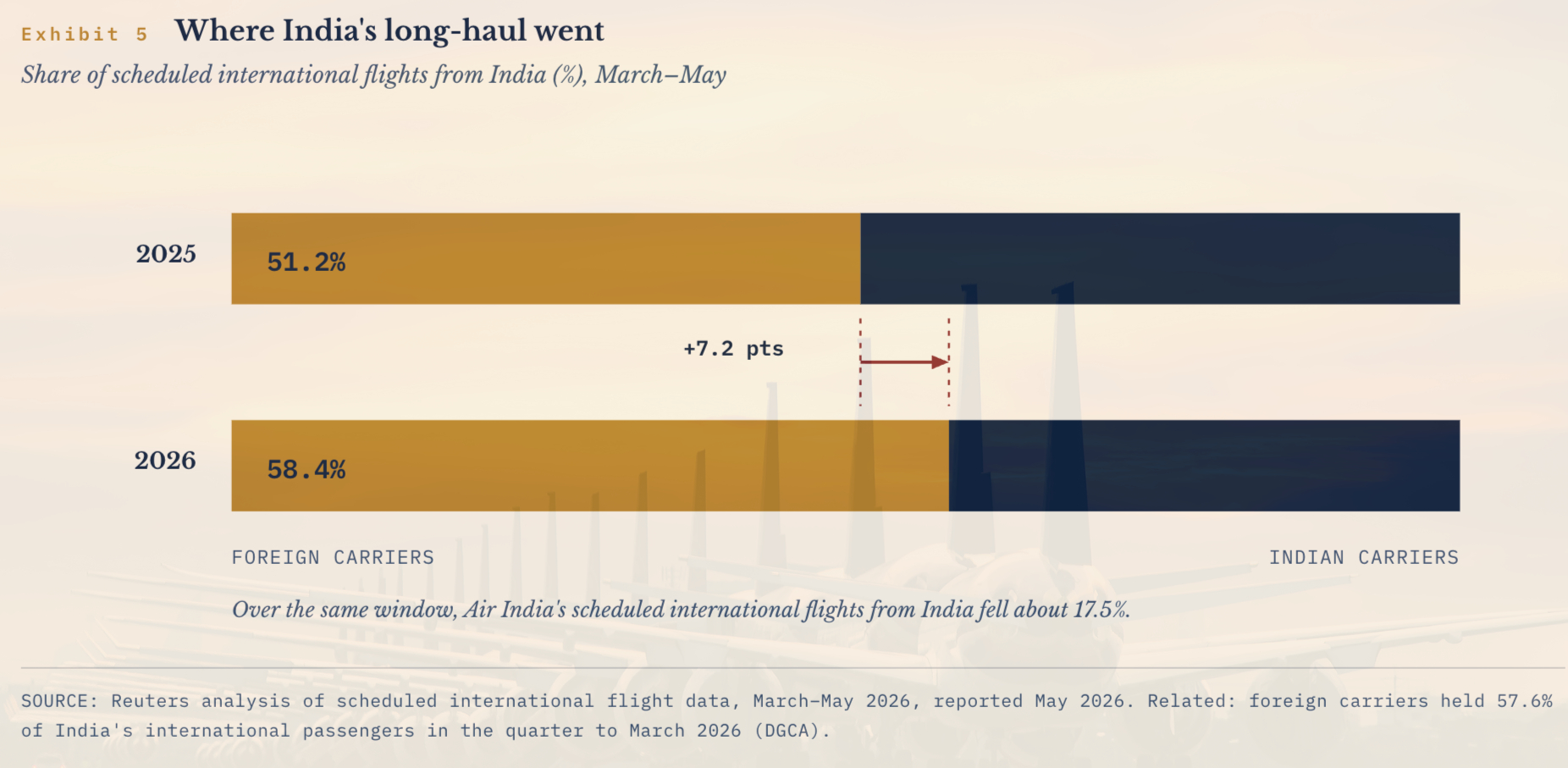
- The competitive set has been misread. Air India's binding contest is not with IndiGo domestically; it is with Gulf and European hub carriers for India-originating long-haul traffic. Foreign airlines took 57.6% of India's international passengers in the quarter to March 2026, and 58.4% of scheduled international flights from India between March and May, up from 51.2% a year earlier.
- Three transformations are running concurrently. A four-airline merger, a fleet-wide retrofit that deliberately removes aircraft from service, and a repositioning to premium full-service — executed simultaneously, under a fuel and airspace shock, with a CEO transition in progress.
- A fixed institutional date is approaching. The AAIB's draft final report on AI171 is expected around October 2026. Whatever it contains, it will reset the narrative frame. The commercial plan should be sequenced around it, not surprised by it.
The corrective is not more transformation. It is a two-year asset-productivity contract; fewer routes flown better, retrofit resequenced out of peak season, bridge capacity leased rather than awaited, and a single published operating scorecard against which the incoming leadership is held. Air India does not need to become a different airline. It needs to fly the one it already owns.
Context and Problem Framing
This analysis covers the Air India Group — Air India and Air India Express — in the period from the completion of the Vistara merger (November 2024) to July 2026, with emphasis on FY26 results published in July 2026.
The three constraints inside which any answer must sit:
- Exogenous cost shock. Aviation turbine fuel accounts for 30–40% of Indian airline operating expenses, and 35–50% of operating costs are US-dollar linked (ICRA). Airspace closures across West Asia and Pakistan have added materially to block times on westbound sectors. ICRA estimated a sector-wide Indian aviation net loss of ₹17,000–18,000 crore for FY26. This is not an Air India-specific shock, and any honest diagnosis must say so.
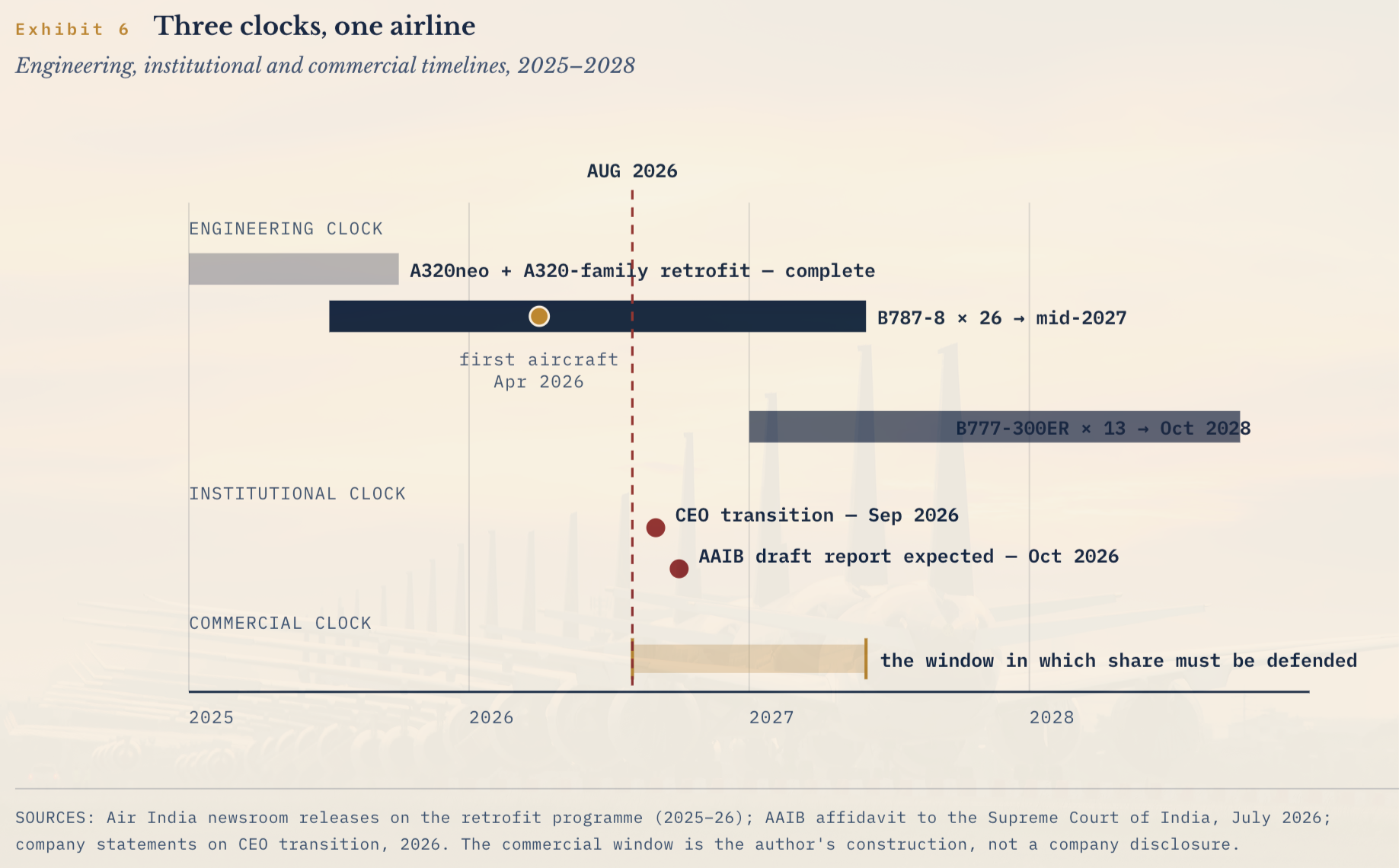
- Deliberate self-shrinkage. The retrofit of 26 legacy Boeing 787-8s (a ~US$400 million programme) removes multiple widebodies from service simultaneously, by design, until at least end-2026. The first retrofitted aircraft was redelivered in April 2026 after roughly 12,825 manhours over 45 days. Thirteen legacy 777-300ERs follow from early 2027, targeted for completion by October 2028.
- Regulatory tightening with personal liability. Between April 2024 and May 2026, the DGCA issued 352-plus enforcement notices across Indian carriers. The Bharatiya Vayuyan Adhiniyam, 2024 extends the regulator's powers beyond monetary penalty, and personal show-cause notices to named executives have become an operative instrument across the industry.
Decision horizon
- Short term (0–12 months): cash preservation, capacity bridge, leadership transition, pre-positioning for the AAIB report.
- Medium term (12–36 months): retrofit completion, network re-concentration, hub depth at Delhi.
- Long term (36+ months): absorption of the ~470-aircraft order book and the actual premium end-state.
Stated Assumptions
Fuel and airspace conditions normalise gradually rather than abruptly. Tata Sons and Singapore Airlines — holding 73.82% and 25.1% respectively — remain committed funders. No adverse regulatory action materially grounds fleet capacity.
Key Insights
Operational — Share is downstream of seats
This is the single most important sentence in this essay: an airline cannot win share it does not have the aircraft to carry.
In June 2026, Air India carried 3.2 million domestic passengers, its lowest monthly figure of the year, against a January peak of 4.0 million. IndiGo carried 8.92 million in the same month. Domestic passengers across all Indian carriers in the first half of 2026 were 86.4 million — up 1.44% on the prior year. Demand did not disappear. It relocated.
The 3.2-percentage-point group share loss between June 2025 and June 2026 corresponds to roughly 430,000 passengers per month at current market volume. Almost none of that is a preference shift. It is a supply shift.
Financial — The unit economics have not yet been fixed, only funded
Two disciplines matter here, and the second is where most commentary fails.
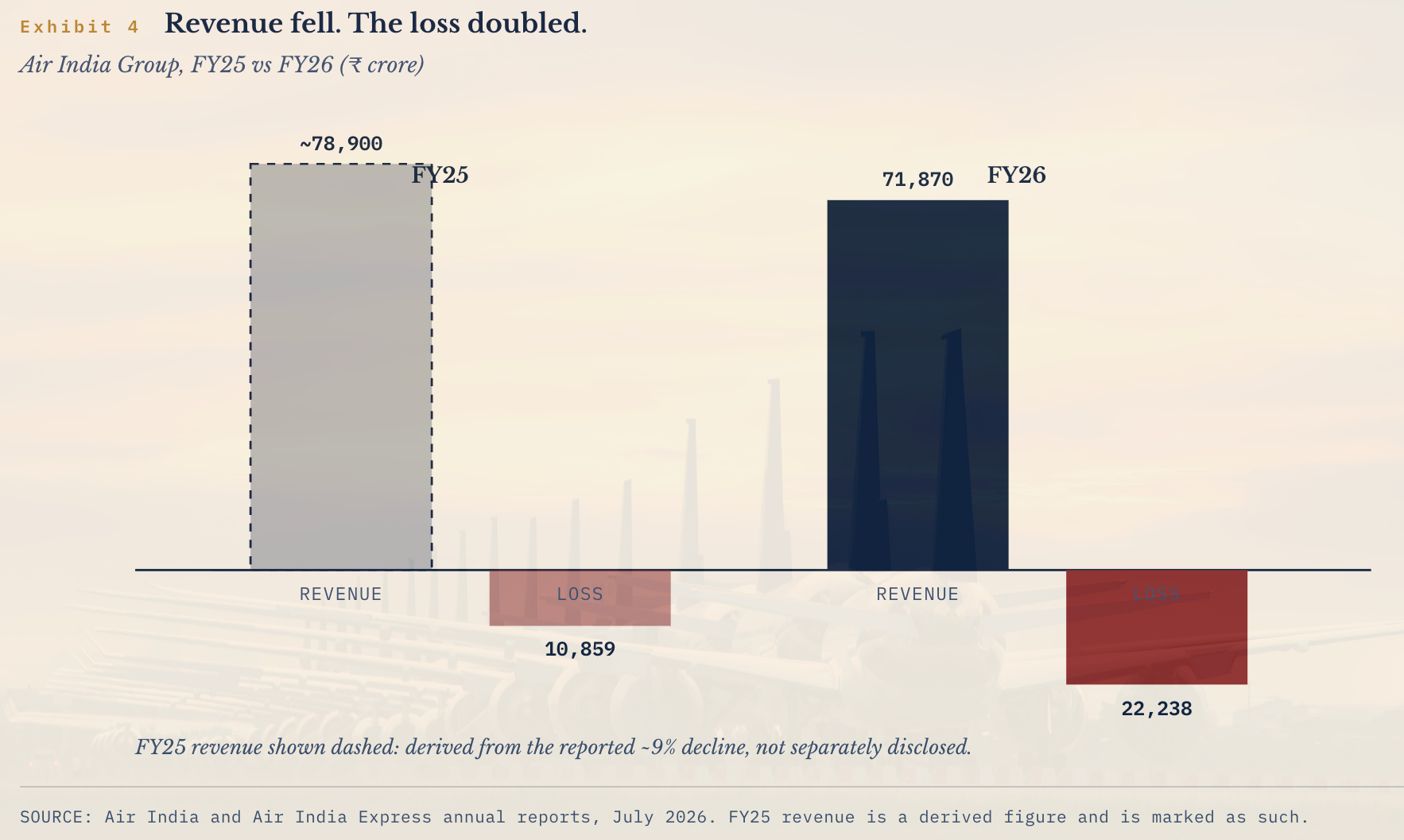
First: the Air India Group loss more than doubled from ₹10,859 crore in FY25, while revenue fell nearly 9%. Losing revenue and widening losses is the signature of a fixed-cost business shrinking its denominator — the aircraft, crew, engineering base, and network overhead remain, while the revenue-generating hours fall.
Second, and in fairness: IndiGo also reported a net loss in FY26. Rupee depreciation and exceptional items were sector-wide. The meaningful distinction is not "one made money and one did not." It is that IndiGo's underlying operating engine generated approximately ₹7,500 crore of profit before those effects, on 9.5% capacity growth, while Air India's underlying engine was contracting. Anyone arguing that Air India's problem is simply legacy PSU culture is not reading the sector's own numbers.
Strategic — The wrong scoreboard is being watched
Domestic share is the metric the Indian press tracks. It is not the metric that determines Air India's viability.
A full-service carrier with a widebody fleet monetises long-haul origin-and-destination traffic and premium cabins. On that scoreboard, the competitors are Emirates, Qatar Airways, Etihad, Singapore Airlines, Lufthansa and British Airways — and they are winning decisively. Foreign carriers held 57.6% of India's international passenger traffic in the quarter to March 2026, and their share of scheduled international flights from India rose to 58.4% between March and May from 51.2% a year prior. Over the same window, Air India's scheduled international flights from India fell approximately 17.5% year-on-year.
The structural asymmetry is fleet depth. India collectively operates on the order of 50 or fewer widebodies capable of genuine long-haul work. Emirates alone operates hundreds, built around transfer traffic. A hub carrier wins by having enough metal to build connection banks — waves of arrivals and departures timed to feed each other. Air India currently has enough metal to fly routes, not to build banks.
This is the core strategic misdiagnosis: Air India has been positioned as a premium product when its competitive deficit is a network topology deficit. Better seats on a thin network still lose to adequate seats on a dense one.
Customer — Bimodal product, and the trust arithmetic
Air India's cabin experience is currently a distribution, not a standard. Of the widebody fleet, one retrofitted 787-8 entered service in April 2026, with the balance of 26 scheduled through mid-2027 and the 777-300ERs through October 2028. On the narrowbody side, 104 A320-family aircraft now carry new or upgraded interiors and 27 legacy A320neos have completed refit — real, verifiable progress.
But a premium fare is a bet on predictability, not on peak quality. When a corporate traveller cannot know from the booking screen whether the aircraft will carry a 2026 cabin or a 2014 one, the willingness-to-pay premium collapses to the level of the worst plausible outcome, not the average. The airline is currently paying for excellence it cannot yet promise.
On-time performance reinforces the point: 82.4% for the Air India Group in April 2026, against 88.5% for IndiGo. The gap is not catastrophic. It is simply insufficient to sustain a price premium against a rival that is both cheaper and more punctual.
This is the intent-to-outcome gap in its purest commercial form. The intent — a world-class Indian global carrier — is coherent, well-funded and correctly conceived. The outcome, at the aircraft-door level, is inconsistent. Consistency, not ambition, is what customers actually purchase.
Institutional — Three clocks running at different speeds
- The commercial clock demands capacity restoration in the next two to four quarters.
- The engineering clock — retrofit, D-checks at Victorville, avionics reliability upgrades on the legacy 787-8 fleet — runs to 2027 and 2028.
- The institutional clock is fixed by others: the AAIB has told the Supreme Court that its draft final report into the AI171 accident of 12 June 2025, in which 260 people died, is expected around October 2026, with the Court's next listing on 13 October.
This review takes no position on the cause of that accident. The investigation is ongoing under ICAO Annex 13 procedure, and its findings belong to the investigators. The strategic observation is narrower and entirely proper: an organisation with a fixed, externally-controlled date on its calendar should sequence its commercial and communications plans around that date rather than be overtaken by it.
Layered on this is a leadership transition, with Campbell Wilson departing by September 2026 and a successor search under way — the fifth variable in a system that already has four.
Implications and Risk Assessment
Strategic risk — share hysteresis. Aviation share, once lost, is expensive to buy back. Corporate travel contracts, tour-operator allotments and frequent-flyer habits reset on annual cycles. Every quarter of reduced capacity hardens a competitor's incumbency.
Financial risk — the funding-fatigue threshold. Cumulative losses across FY25–FY26 exceed ₹33,000 crore for the group. The chairman's framing of a decade-scale transformation is an explicit signal to shareholders. The risk is not that funding stops; it is that the internal cost of continued funding shifts the airline's decision-making from ambition to austerity at precisely the moment ambition is required.
Regulatory risk — personal accountability. With named-executive show-cause notices now standard practice and expanded statutory powers under the 2024 Act, the risk profile of managerial decisions has changed. This has a subtle operational consequence: it makes middle management conservative, slowing exactly the decisive rostering and scheduling calls that a capacity-constrained airline needs.
Second-order effect — national economic leakage. Every India–Europe or India–North America passenger routed via Dubai, Doha or Abu Dhabi transfers aviation value-add, MRO demand, crew employment and hub tax revenue offshore. Air India's capacity contraction is therefore not solely a corporate matter; it is an economic-sovereignty question about whether India's outbound traffic is intermediated at home or abroad.
Third-order effect — competitive concentration. IndiGo at 66.3% domestic share raises questions of market structure that a regulator will eventually have to consider. A structurally weakened Air India is not only a Tata problem; it is a competition-policy outcome.
Options and Strategic Pathways
Option A — Stay the course
Complete the retrofit and merger integration as planned; absorb the share loss; scale from FY28 on the order book.
Pros: Preserves the premium end-state; avoids write-offs; internally coherent. Cons: Concedes two more years of share; compounds losses at current run-rate; permits competitor entrenchment.
Execution complexity: Low. Financial exposure: Highest.
Option B — Concentrate to a defensible spine
Prune routes to those clearing a defined contribution-margin threshold; concentrate frequency and connection banks on Delhi and Mumbai; move volume short-haul decisively to Air India Express with a genuinely separate cost base.
Pros: Improves asset productivity immediately; restores unit economics; makes the premium promise deliverable on the routes that remain.
Cons: Publicly reads as retreat; strands slots and bilateral entitlements; politically uncomfortable for a carrier bearing national identity.
Execution complexity: Medium.
Financial exposure: Medium, front-loaded.
Option C — Bridge the capacity gap with others' metal
Damp and wet leases, deeper Star Alliance and Singapore Airlines codeshare density, and metal-neutral joint ventures on Europe and North America to hold origin-and-destination share until owned capacity arrives in FY28.
Pros: Fastest defence of share; preserves network presence through the retrofit trough; low capital intensity.
Cons: Margin dilution; product-consistency risk on leased metal; dependence on partner priorities; bilateral and regulatory friction.
Execution complexity: High.
Financial exposure: Low-to-medium.
Option D — Formal two-brand separation
Run Air India (premium long-haul) and Air India Express (volume short-haul) as genuinely separate P&Ls with distinct cost structures, brand promises and capital allocation, ending the averaging that currently obscures where value is created and destroyed.
Pros: Restores accountability clarity; permits differentiated cost discipline; makes each business individually assessable.
Cons: Loses some merger synergy; duplicated overhead; complex given completed integration work.
Execution complexity: High.
Financial exposure: Medium.
What we would do
My recommendation: Adopt Option B as the strategic spine, Option C as the bridge, and embed the accountability discipline of Option D within the existing structure.
The reasoning is first-principles. An airline's economics are governed by one dominant equation: revenue per available seat kilometre must exceed cost per available seat kilometre, sustained across a network dense enough to generate connecting traffic. Air India currently fails on all three terms simultaneously — insufficient seats, elevated unit cost, and insufficient density. Retrofit improves the product but does not solve any of the three; in the short run it worsens the first. The correction must therefore be an asset-productivity programme, not a further transformation programme.
- Days 0–30 — Establish the scoreboard.
- Define the incoming chief executive's mandate explicitly around asset productivity and reliability, not transformation narrative. The mandate should be written, board-approved, and time-bound to eight quarters.
- Publish a single group operating scorecard: aircraft-days available, block hours per aircraft per day, completion factor, on-time performance, CASK ex-fuel, and RASK. Six numbers, monthly, one page.
- Stand up an Integration and Reliability War Room with authority over rostering, engineering scheduling and network — the three functions whose misalignment is currently costing the most.
- Days 31–60 — Rebuild the capacity bridge.
- Resequence the retrofit calendar to concentrate aircraft downtime in demand troughs rather than peaks. The programme's completion date matters less than the seasonality of its withdrawals.
- Execute a defined damp-lease bridge for the FY27 widebody trough, sized to hold the top long-haul corridors at competitive frequency.
- Apply a contribution-margin threshold to every route; exit or reduce below it without exception, and redeploy the freed hours into frequency on retained corridors.
- Days 61–90 — Secure the institutional position.
- Complete an independent safety-management-system review and pre-commit publicly to implementing the AAIB's eventual safety recommendations in full. Doing this before October is a materially different act from doing it after.
- Present the board and shareholders with a two-year, three-metric turnaround contract — unit cost, completion factor, and long-haul share of India-originating traffic — with quarterly reporting.
- Open a structured dialogue with the Ministry of Civil Aviation on bilateral entitlement utilisation and hub development at Delhi, framed as national aviation-value retention rather than carrier relief.
- Phase 2 (FY27) — Densify.
Build genuine connection banks at Delhi. Expand metal-neutral joint ventures. Achieve product uniformity on at least one full long-haul corridor end-to-end, and market that corridor as the guaranteed standard — converting the bimodal fleet problem into a marketable certainty on a defined subset.
- Phase 3 (FY28) — Scale.
Absorb order-book deliveries into a network whose unit economics have already been proven at smaller scale. Scaling a profitable system is arithmetic; scaling an unprofitable one is compounding.
- Governance.
- A standing board Transformation Audit Committee with an independent chair, reporting on delivery against the six-metric scorecard.
- Voluntary quarterly operating disclosure. An unlisted airline is not obliged to disclose — but a minority shareholder in Singapore Airlines is listed and does, and the discipline of external measurement is itself a management technology.
- Named single-point accountability for each of the three clocks: commercial, engineering, institutional.
Scenarios (FY27–FY28)
Downside | Base | Upside | |
Fuel & airspace | Prolonged disruption | Gradual normalisation | Rapid normalisation |
Group domestic share | Below 22% | 24–26% | 27–29% |
Retrofit delivery | Slips beyond 2028 | On current schedule | Accelerated |
Loss trajectory | Widens further | Halves by FY28 | Approaches operating breakeven FY29 |
Long-haul O&D share | Continued erosion to foreign hubs | Stabilised | Recovery begins |
Scenario bands are analytical constructions from the trend data cited, not forecasts. They are offered as a planning frame, not a prediction.
Conclusion
Air India's difficulty is instructive well beyond aviation, and it is the same difficulty this publication has traced across Indian public delivery for years: the distance between announced intent and delivered outcome is not closed by capital, and it is not closed by ambition. It is closed by operating discipline exercised on a small number of measurable things, relentlessly, for longer than anyone finds interesting.
The Tata Group bought an airline with an extraordinary brand, sovereign-scale bilateral entitlements, and the largest aircraft order in the country's history. Four years later, its most binding constraint is the number of aircraft it can put in the air on any given morning. That is not a failure of vision. It is the ordinary, unglamorous arithmetic that every operating business eventually has to answer to.
The airline that solves that arithmetic first will own the Indian sky for a generation. On present evidence, it is not the one with the better story.