India's Demographic Clock — The Deadline Beneath Every Other Debate
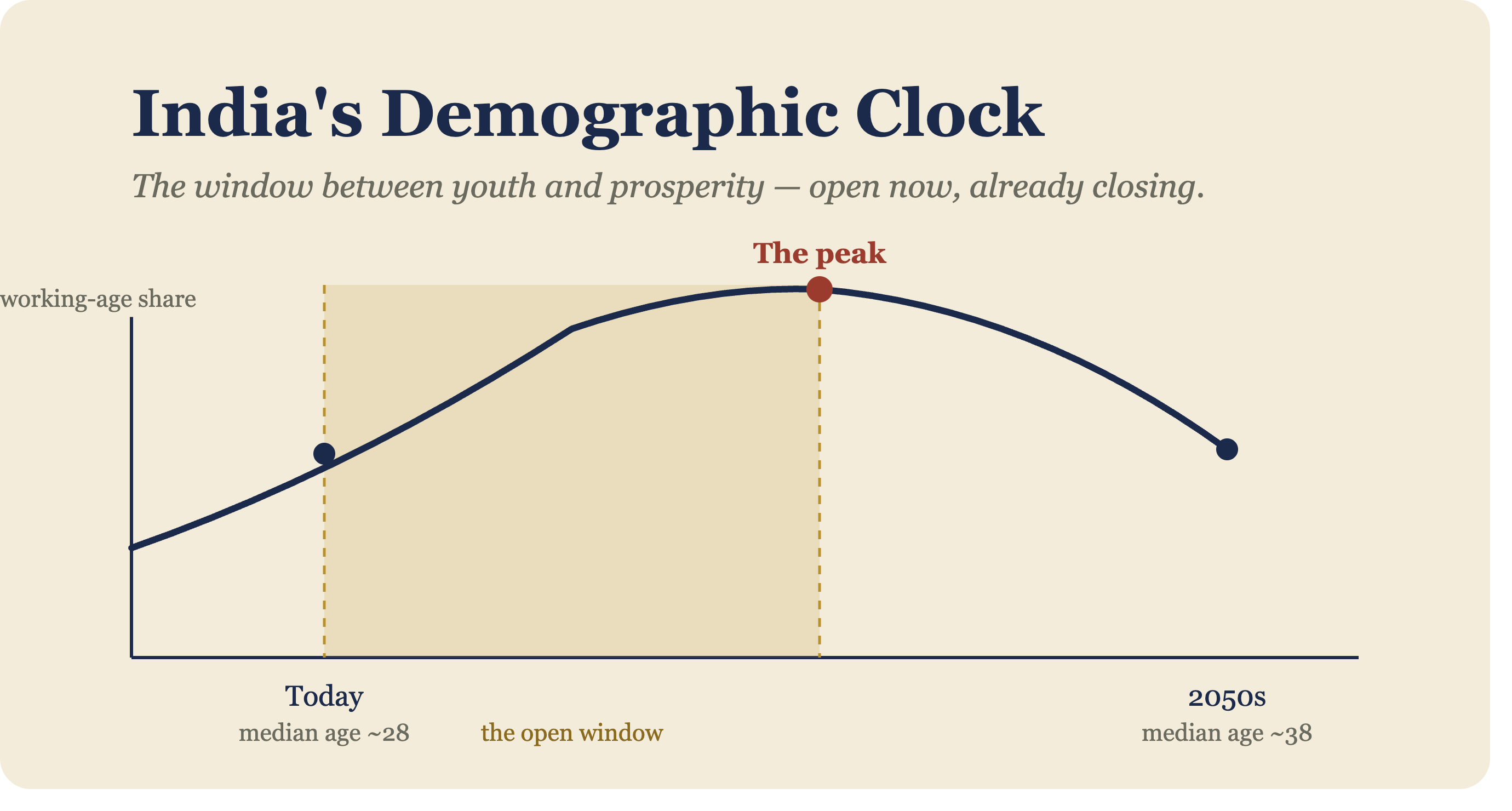
A median age of 28 in an ageing world is India's greatest advantage and its deadline. The working-age share peaks in the 2040s; everything else is a question of what gets delivered before then.
ProvenancePublished 11 June 2026; revised 31 August 2026 to add a provenance line. The projected peak of the working-age share in the early-to-mid 2040s and a median age near 38 by 2050 are population projections, not measurements, and different projection sets place the peak in different years. The observation that only a handful of countries have moved from middle to high income since 1990 is the standard middle-income-trap finding in the development literature. The skilling figures — 13.7 million trained and 18 per cent placed — are the same scheme figures this Review examines in detail elsewhere, and carry the same caveat: they are the scheme’s own reporting on its own definitions, which a Comptroller and Auditor General audit has questioned. Data vintage note: every dated claim in this essay is a projection, and the argument does not depend on the precise year the window closes.
India's greatest advantage is a young population, and it is also a deadline. The window in which youth becomes prosperity is open now, and it is already beginning to close.
There is a clock running underneath every conversation about India's rise, and most of our politics behaves as though it cannot hear it ticking. India today is young in an ageing world — a median age of about 28, against 38 in China and 48 in Japan, with roughly two-thirds of its people of working age. This is the celebrated demographic dividend, and it is real. But a dividend is not a possession; it is an opportunity with an expiry date.
Four findings anchor this analysis:
- The window has a measurable end. The working-age share of India's population is projected to peak in the early-to-mid 2040s and then decline as fertility falls below replacement. By 2050 the median age will be near 38 — roughly where China is now.
- The dividend is conditional, not automatic. A young population is potential: a large cohort of working age relative to dependents. It becomes a dividend only if those people are healthy, educated, skilled and employed in work productive enough to lift incomes. A young person without productive work is not a dividend; in the arithmetic of development, they are a cost and a risk.
- The failure mode is well documented. Of the many countries that have escaped poverty into middle income, only a handful since 1990 have gone on to become high-income economies. The rest stalled in the middle-income trap, their early growth drivers exhausted before prosperity arrived. A squandered demographic dividend is one of the surest routes into it.
- Delivery failure is irreversible against a clock. A skilling system that trains 13.7 million people and places 18 per cent of them is a chronic inefficiency in an ageing country. In a young country with a closing window it is an emergency, because every cohort it fails will never pass through the working-age bulge again.
A dividend is earned, not awarded
The word "dividend" flatters us into thinking the thing is automatic. It is not. The conditions attached to it are precisely the things India is least reliably good at delivering: jobs at scale, skills that match work, health and education that reach the last child.
Demography hands India the raw material of prosperity. Whether it becomes prosperity is a question of delivery — and the distance between what is announced and what arrives is the subject this Review keeps returning to, because it is the same distance in every sector.
The clock and the gap, in one frame
Read India's delivery failures against the demographic clock and their stakes change entirely. The young person not skilled today is not skilled later; there is no later that returns them to the front of the demographic wave. The dividend is paid out year by year, in real people entering the workforce, and a year of failed delivery is a year of the dividend lost permanently.
This is why the intent-to-outcome gap is not a technocratic concern for specialists. It is the hinge on which India's century turns. A government that confuses announcements with achievements can get away with it for a long time in a slow-moving system. It cannot get away with it against a clock.
What converting the dividend actually requires
If the dividend is earned through delivery, the agenda is not mysterious. It is unglamorous and well known, which is precisely why it is neglected in favour of louder things.
Productive jobs, not merely jobs. The youth-unemployment problem is real, but the deeper problem is the quality of work: too much of the workforce sits in informal, low-productivity employment that does not raise incomes. Converting the dividend means absorbing the young into work productive enough to compound.
Skilling judged by livelihoods. Until training is measured by whether a young person can earn a living — designed where they live, fitted to markets that exist, honest about its own results — it will keep producing certificates the economy does not value.
Health and education that actually reach the child. The dividend is being decided now, in classrooms and clinics, for cohorts who enter the workforce a decade hence. Learning outcomes and child health are the slow, invisible foundations; neglect them and the dividend is lost before it arrives.
Women in the workforce. India's female labour-force participation remains far below its potential. No country has converted a demographic dividend while leaving half its working-age population on the sidelines. This alone could change the arithmetic.
The counter-case, honestly stated
Three arguments cut against this analysis, and each has force.
First, there is no national clock. India's fertility transition is not synchronous, and the aggregate conceals states moving in opposite directions. The Economic Survey 2023-24 statistical appendix puts NFHS-5 fertility at 1.7 in Karnataka and Andhra Pradesh, 1.8 in Kerala and 1.3 in Goa, against 3.0 in Bihar; PRS Legislative Research noted that among the medium and large states it reviewed, Bihar alone remained above replacement. A deadline located in the 2040s therefore describes no actual state. For Kerala and Tamil Nadu the window is closing now; for Bihar and Uttar Pradesh it runs considerably longer. Policy written against a national average will be late in the South and early in the North, and the mechanism that makes the aggregate cohere at all is the internal migration this Review has argued is inadequately provided for.
Second, the premise is weaker than it was when the phrase was coined. The Ministry of Health and Family Welfare's sixth National Family Health Survey, conducted in 2023-24 and released in May 2026, records a national total fertility rate of 2.0 — below the replacement level of 2.1, and unchanged from NFHS-5, according to the Press Information Bureau. India is not a young country with a long runway that must be used before fertility falls. Fertility has already fallen. The dividend argument is therefore about the age structure now working its way through the population rather than about a demographic advantage still being generated, and that is a materially shorter and less forgiving proposition than the essay's framing implies.
Third, "irreversible" is too strong. A cohort that misses training at twenty-two is not permanently unproductive. Workers already in the labour force become more productive through sectoral reallocation, mid-career reskilling and movement from low-productivity agriculture into services and manufacturing, and in most late-industrialising economies rising output per worker did more to raise incomes than the arrival of additional young workers. What closes in the 2040s is a tailwind, not the possibility of improvement. Treating every year of delivery failure as a permanent write-off is rhetorically effective and analytically imprecise.
The operational conclusions are unaffected. A state cohort ledger and a female participation target with a named owner are correct whatever the clock reads. What the objections weaken is the deadline framing, which is carrying more argumentative weight than the demography supports.
What we would do
Four disciplines would put a state government on the right side of the clock.
- Publish a state cohort ledger. How many young people enter the workforce in your state each year, how many enter productive employment, and what happened to the balance. No state currently publishes this, which is why the dividend is discussed in adjectives rather than numbers.
- Set the female participation target explicitly, with a named owner. It is the largest single lever available and the one most consistently left to aggregate hope. Childcare provision, transport safety and shift regulation are the instruments; each belongs to a department that can be held to a number.
- Convert every training rupee to an outcome measure at twelve months. Not enrolment, not certification, not placement at exit — earnings retained at a year.
- Treat foundational learning as economic policy and fund it as such. The cohort that will carry India's ageing is in primary school now. Every year of foundational failure is compounded at the far end of the window, when it can no longer be corrected.
Sometime in the 2040s the working-age share will peak and begin to fall, the dependency ratio will climb, fiscal space will tighten, and demography will stop being a tailwind. After that, growth must come from productivity and institutions rather than from sheer numbers of young workers — a far harder feat, which most countries do not manage.
India has a window of perhaps fifteen to twenty years in which the decisions are still ours to make freely. The most important number in Indian public life is not a GDP figure or an opinion poll. It is the number of years left on the clock, and what we choose to do with them. A nation is judged not by what it announces but by what reaches its last home; against the demographic clock, that is no longer a principle of good governance. It is a deadline.
Sources named in this essay
- Press Information Bureau
- PRS Legislative Research
- National Family Health Survey
- Economic Survey of India
- Ministry of Health and Family Welfare
Every figure in this essay is attributed in the text to the instrument and release that produced it. Links resolve to the publishing institution; the specific release is named inline.