The Campus Economy — India's Quietest Special Economic Zones
Roughly 37% of notified SEZ land is in use. Meanwhile four university gates have built the concentrated capital, talent and IP pools that SEZ policy spent twenty years trying to engineer.
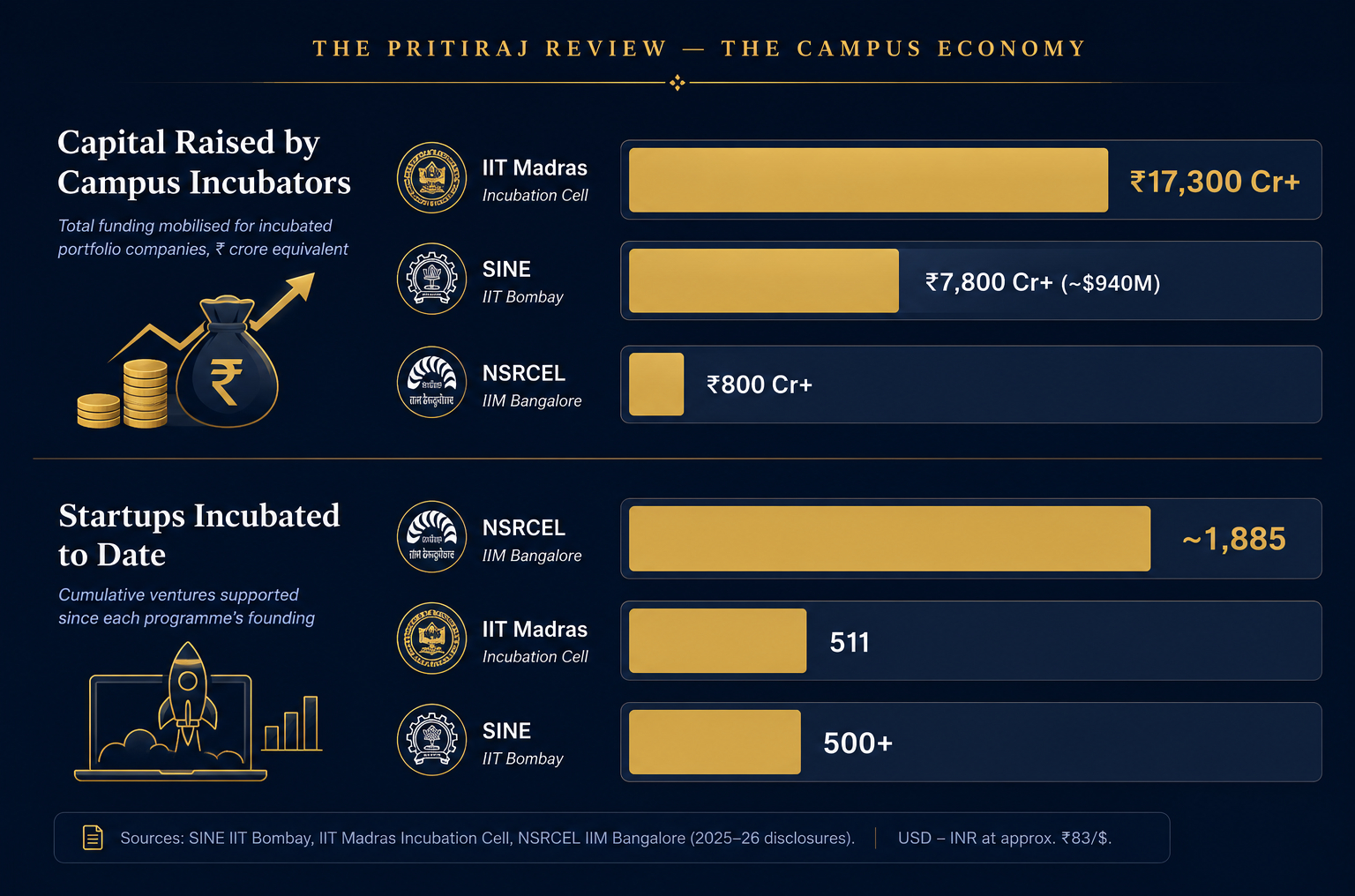
ProvenancePublished 18 June 2026; revised 31 August 2026 to add a provenance line. SEZ land utilisation of roughly 37 per cent, vacant processing-area land of 45 to 50 per cent, the share of non-operational notified SEZs at around 40 per cent and the 466 SEZs formally shut down in the five years to FY25 are from national land-utilisation studies and government replies to Parliament. Incubator figures — IIT Madras’s ₹17,300 crore mobilised across 511 startups on a ₹53,000 crore combined portfolio valuation, SINE at IIT Bombay’s 500-plus startups and $940 million raised since 2004, NSRCEL at IIM Bangalore’s roughly 1,885 ventures and over ₹800 crore in portfolio fundraising, and the 61 per cent of IIT Madras founders with no formal association with the institute — are as published by the incubators themselves. The 68 Atal Incubation Centres are the Atal Innovation Mission’s figure. Data vintage note: incubator portfolio valuations are self-reported, marked to the most recent funding round, and are not audited; they indicate scale and should not be read as realised value.
India spent two decades trying to legislate growth zones into existence. The zone that actually worked needed no land acquisition act at all — only a gate, a library, and twenty years of graduates cycling back as investors.
For two decades, Indian industrial policy tried to manufacture growth zones by decree: carve out land, waive the taxes, promise the power and the ports, and wait for capital to arrive. Most Special Economic Zones never filled up. Meanwhile, without a single land acquisition notice or ministry press release, four university gates quietly built what SEZ policy spent twenty years trying to engineer — concentrated, self-renewing pools of capital, talent and intellectual property that compound faster than almost any city-based industrial cluster India has produced since Independence.
This is not a metaphor about ambition. It is a balance sheet.
Five findings anchor this analysis:
- The SEZ shortfall is structural, and the resource that failed is land. National land-utilisation studies put actual usage of notified SEZ land at roughly 37 per cent, with vacant land running as high as 45 to 50 per cent of the area specifically set aside for processing. Government replies to Parliament have put the share of non-operational notified SEZs at around 40 per cent in recent years, and in the five years to FY25 some 466 SEZs were formally shut down — close to a tenth of all SEZs the Union government has ever approved.
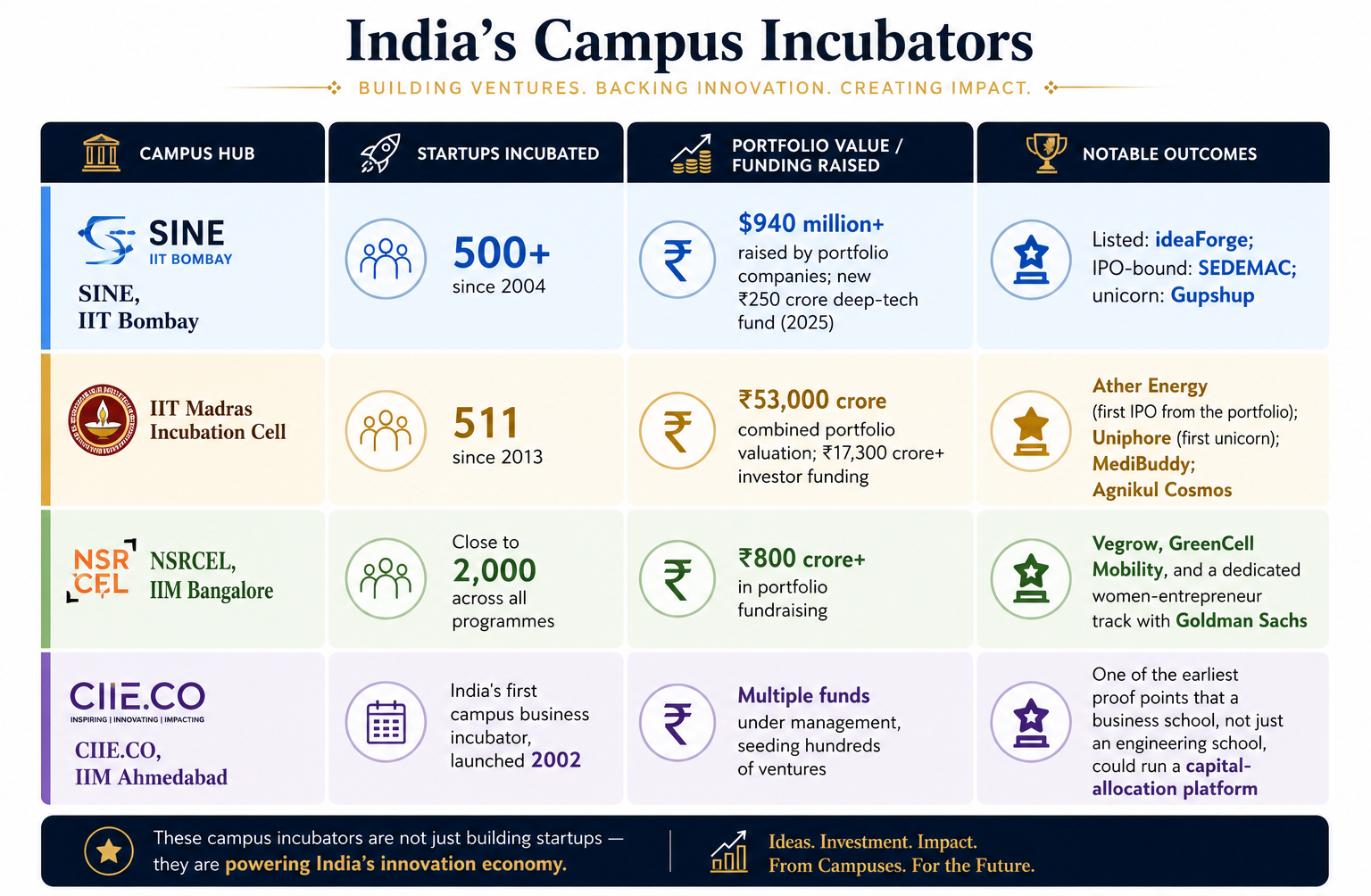
- Campus incubation now runs at industrial-cluster scale, on venture capital rather than subsidy. IIT Madras's incubation cell has mobilised over ₹17,300 crore in investor funding across 511 startups, on a combined portfolio valuation of ₹53,000 crore. SINE at IIT Bombay has backed 500-plus startups since 2004, raising north of $940 million and producing a listed company (ideaForge), an IPO-bound one (SEDEMAC) and a SaaS unicorn (Gupshup).
- The model is not confined to engineering. NSRCEL at IIM Bangalore has touched close to 1,885 ventures across its programmes, with over ₹800 crore in portfolio fundraising. CIIE.CO at IIM Ahmedabad, launched in 2002, was India's first campus business incubator and remains one of the earliest proof points that this could work at all.
- The platform has opened to outsiders — the decisive shift. Sixty-one per cent of the founders incubated at IIT Madras today have no formal association with IIT Madras.
- Policy is now copying the campus, not the zone. The Atal Innovation Mission has stood up 68 Atal Incubation Centres nationally, most structured on the faculty-mentor, equity-light template pioneered by SINE and NSRCEL two decades ago. The Startup India Seed Fund Scheme has empanelled more than 250 incubators for equity-free grants, and the majority of the credible ones are academic.
The zone that actually worked
The SEZ model bet that if you assembled land, tax breaks and infrastructure in one place, capital and talent would follow. In practice the hardest parts — talent density, mentorship, patient early capital, and a credible flow of intellectual property — were exactly the parts the policy could not manufacture. You cannot legislate a research lab into existing at short notice, and you cannot zone your way into forty years of accumulated faculty expertise.
A campus starts with precisely the inputs an SEZ spends a decade trying to attract. The lab space already exists. The intellectual property is already being generated as a byproduct of research rather than as the goal of a subsidy scheme. The mentors are already on payroll, in the form of faculty who supervise theses and increasingly sit on cap tables. And the capital need not be lured in from outside — it is often supplied by the institution's own alumni, cycling back as angel investors and fund managers who understand the technology because they were trained in the same labs.
The SEZ tried to build an ecosystem around an empty plot. The campus already was one.
Three things the numbers say that the headline does not
The capital was raised, not granted. It came at market terms from venture investors under no institutional obligation to write the cheque. IIT Madras's incubation cell moved from a modest research-park initiative in 2013 to a platform overseeing more than fifty thousand crore in portfolio value without a corresponding SEZ-style subsidy programme. Where government participates, it participates as a co-investor: the Research Park's ₹600 crore deep-tech fund with Unicorn India Ventures, announced this February, is a joint vehicle, not a grant disbursement.
The pace is accelerating, not plateauing. IIT Madras crossed the threshold of incubating over a hundred deep-tech startups in a single financial year for the first time in 2025 — a rate that would have taken the institution's first decade to achieve in total.
These campuses are the productive core of a much larger population. India now ranks third globally by startup count, with more than 120,000 DPIIT-recognised startups and over 700 active incubation and acceleration programmes. A small number of those — perhaps a few dozen, concentrated overwhelmingly at the IITs and older IIMs — account for a disproportionate share of the credible, VC-backed outcomes. The campus is not one input among seven hundred equal ones; it is the part of the distribution doing most of the work.
The 61 per cent signal
The single most important data point in this story is not a valuation figure. It is a composition figure: 61 per cent of founders incubated at IIT Madras have no formal association with the institution.
That quietly rewrites what a campus economy means. The original theory of change for a university incubator was narrow — help your own students and faculty commercialise their research. What has happened instead is closer to what an SEZ was supposed to be and rarely became: an open platform any credible founder in the country can plug into, because the campus offers something a zoning authority never could — a functioning, reputationally-anchored talent and capital market that outsiders trust enough to relocate for.
The institutional brand has become the underwriting mechanism. A founder with no IIT degree who is incubated at IIT Madras inherits access to its mentor network, its lab infrastructure and increasingly its capital — the exact bundle an SEZ promised on a signboard.
Why campuses won a game cities were built to win
They sidestep land acquisition politics. An SEZ needs contiguous land, usually agricultural, usually contested. A campus incubator needs a floor of an existing building. IIT Madras's Research Park runs its ecosystem out of just over eleven acres and 1.2 million square feet — a footprint smaller than a single mid-sized SEZ — and has still produced a fifty-thousand-crore portfolio, because the constraint was never land. It was trust, mentorship and a credible signal to capital.
They own the mentor and capital supply chain. When IIT Madras launched its deep-tech fund in February, the launch was attended by the co-founder of Ather Energy, the institute's own incubated unicorn — whose presence is itself the pitch. Alumni who built companies inside the ecosystem return as mentors, angels and fund managers. No SEZ authority can reproduce that loop, because an SEZ does not graduate anyone. A campus does, every year, on a fixed calendar, indefinitely.
The state has begun to concede the point. Kerala's Campus Industrial Park Scheme, launched to address a chronic shortage of usable industrial land, proposes building industrial parks inside higher-education campuses rather than acquiring fresh land at all — a tacit admission from a state government that the campus gate is a more reliable site for industrial activity than the industrial estate.
The global echo
None of this is unprecedented. Stanford's proximity to what became Silicon Valley, and MIT's role in seeding the Route 128 corridor, followed the same mechanic: a research university with patient capital, a culture tolerant of faculty and student entrepreneurship, and a multi-decade horizon no five-year plan cycle can replicate. China's answer was more deliberate — Tsinghua Science Park and the broader university-science-park movement were built as explicit state policy, backed by land, tax and procurement preference, because Beijing had studied the American model and concluded the campus, not the city, was the right unit of industrial planning.
India's version arrived from the opposite direction: bottom-up, largely unplanned, built by institutions moving faster than the ministries meant to be designing their replacement. That India reached a similar structural conclusion without a top-down mandate is, if anything, more encouraging — it suggests the model works even when nobody is deliberately engineering it.
The counter-case, honestly stated
Three arguments cut against this analysis, and each has force.
First, the model has not scaled to the country. It has scaled to roughly half a dozen institutions with the faculty depth, alumni density and two-decade head start to make it work. Extending it to India's other few thousand higher education institutions — most lacking even the basic research infrastructure IIT Madras had in 2013 — is a genuinely harder problem than replicating a fund structure.
Second, the results may reflect selection rather than creation. The IITs and the older IIMs admit a very small fraction of applicants through national competitive examination, and an incubator drawing on that population would post strong outcomes while adding little. The 61 per cent outsider figure is offered as proof that the platform has opened, and it is consistent with that reading. It is equally consistent with the brand doing the work: a founder capable of clearing IIT Madras's screening is himself heavily selected, whether or not he holds its degree. Separating what the campus adds from the quality of people it filters would require a comparison this data cannot supply, and the essay treats the composition figure as settling a question it only reframes.
Third, the comparison with Special Economic Zones is not like for like, and it flatters the campus. SEZs were instruments of export manufacturing employment in specified locations, judged on jobs and shipments. Campus incubators produce high-value, low-headcount deep-tech firms, judged on portfolio valuation. A ₹53,000 crore mark is not a substitute for factory employment, and a state that moves industrial policy from land to incubation may improve its innovation statistics while employing materially fewer people. The asymmetry runs deeper than the metric: 37 per cent land utilisation is a measured fact about a physical asset, while a portfolio valuation is an unrealised mark that moves with the venture cycle. Setting the two side by side as comparable verdicts overstates the contrast.
The policy conclusion survives, on a narrower claim than the essay makes. Underwriting institutions beats underwriting empty land as a route to innovation capacity. It is not yet an employment strategy, and it should not be sold as the replacement for one.
What we would do
- Stop underwriting land and start underwriting institutions. If 37 per cent utilisation is the return on the land-first model, the marginal rupee of industrial policy belongs in incubation capacity at institutions that already hold the talent, not in a fresh notification.
- Open every publicly funded incubator to outside founders, and publish the ratio. The 61 per cent figure is the single best indicator that an incubator has become a platform rather than a placement service. It should be a reported metric for every Atal Incubation Centre and Seed Fund empanelment.
- Co-invest, do not grant. The campus results were produced by market-terms capital with government as co-investor. That structure disciplines selection in a way a grant never does.
- Build the second tier deliberately. Identify twenty state universities with genuine research depth and fund a decade of incubation capacity — faculty time, IP support, seed capital — rather than spreading thin grants across hundreds of institutions with no lab to commercialise from.
- Follow Kerala's logic into the industrial land question. Where a state has land inside its campuses and none outside, the campus industrial park is not a compromise. It is the better instrument.
India spent twenty years trying to build growth zones that needed a land acquisition act, a tax notification and a prayer that capital would show up. The zone that actually worked needed none of those things. The next great Indian industrial cluster will not be inaugurated with a ribbon. It will be a lab that has been quietly running for twenty years, one floor above a hostel.
Sources named in this essay
- Parliament of India
- Ministry of Commerce and Industry
- Department for Promotion of Industry and Internal Trade
- Government of India
Every figure in this essay is attributed in the text to the instrument and release that produced it. Links resolve to the publishing institution; the specific release is named inline.