The Northeast Is Not the Periphery — A Gateway That Is Not Yet Open
Over ₹6 lakh crore committed in a decade, and the region's exports fell from $50.8m to $47.6m. The gateway framing is right; the execution gap is the whole problem.
ProvenancePublished 28 May 2026; revised 29 August 2026 for the palette change and 31 August 2026 to add a provenance line. Cumulative expenditure of over ₹6 lakh crore across the past decade reflects the mandated ten per cent budgetary support for the region. National highway length grew from under eleven thousand kilometres in 2014 to over sixteen thousand by early 2025 on Ministry of Road Transport and Highways figures. Export figures of around $50.8 million in 2013 against $47.6 million in 2023 are as published; both are small absolute numbers and the comparison is a decade apart, so it should be read as a direction rather than a precise decline. The claim that informal cross-border trade in Manipur and Mizoram exceeds formal trade is, by the nature of informal trade, an estimate and is described as believed rather than measured. The India-Myanmar-Thailand Trilateral Highway is described as unfinished, which remained the position at the date of revision.
For decades the Northeast was governed as a frontier to be secured and subsidised. It is in fact a gateway central to India's future — and whether it becomes one is, once again, a question of delivery.
I am from the Northeast, so let me begin with a frustration anyone from the region will recognise. For most of independent India's history, the eight states east of the Siliguri corridor have been governed as a problem to be managed rather than a place to be built — a frontier to be secured, a population to be subsidised, a periphery to be kept quiet. The map of the national imagination thins out east of Bengal, and that habit of mind, more than any single policy, is what has held the region back.
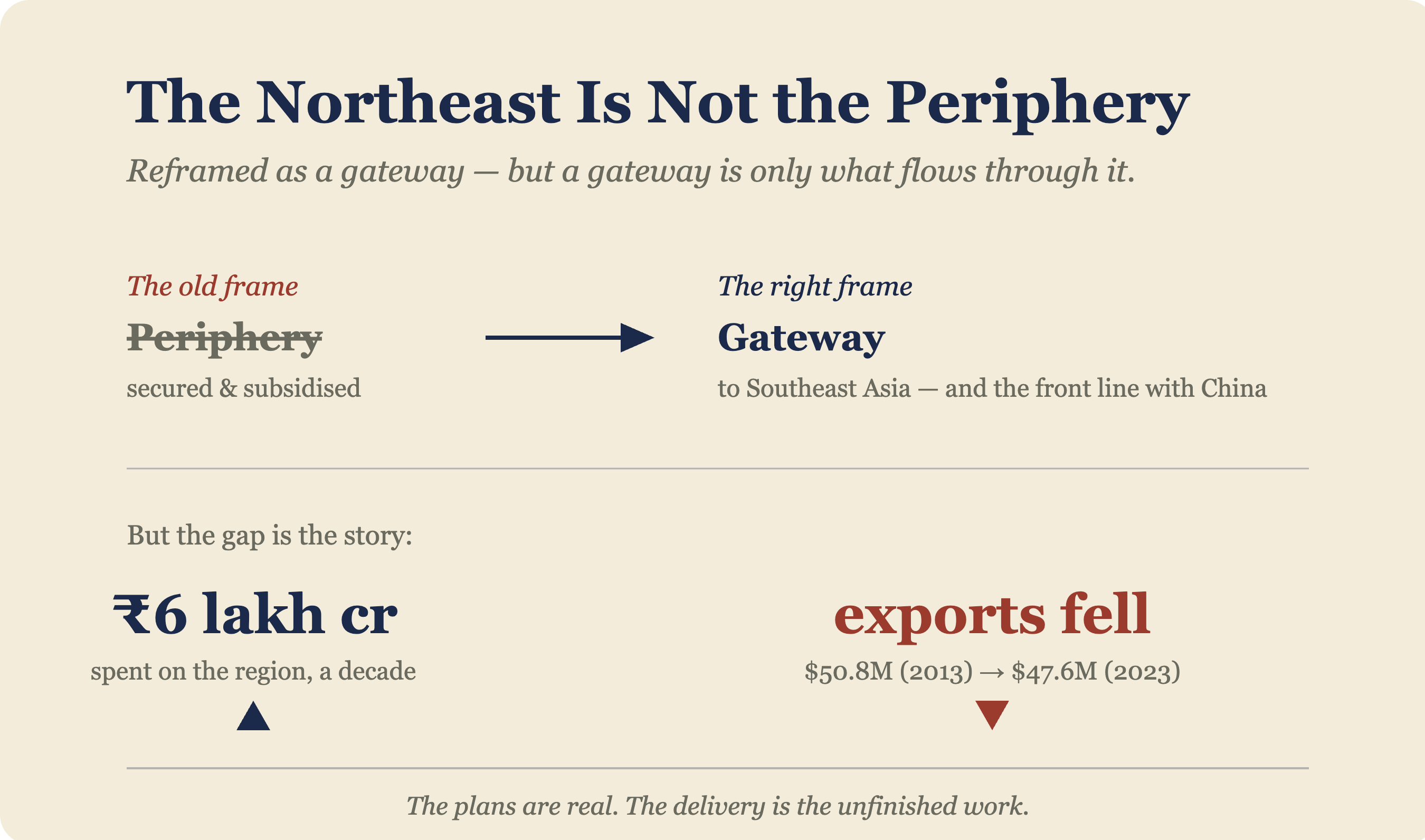
Four findings anchor this analysis:
- The commitment is real and historically large. Cumulative expenditure of over ₹6 lakh crore on the region's development across the past decade under the mandated ten per cent budgetary support; national highway length grown from under eleven thousand kilometres in 2014 to over sixteen thousand by early 2025; rail lines reaching, for the first time in independent India's history, into places like Mizoram.
- Trade moved the wrong way over the same decade. The Northeast's exports fell from around $50.8 million in 2013 to $47.6 million in 2023, even as India's total exports surged by more than a third. A gateway through which less and less flows is, so far, a gateway in name.
- The binding constraint is preparedness, not opportunity. The region sits at the crossroads of South and Southeast Asia and remains structurally disconnected from both — missing logistics, incomplete digital integration, thin institutional support. The India–Myanmar–Thailand Trilateral Highway, the physical spine of the whole gateway idea, remains unfinished.
- The formal channel is losing to the informal one. Informal cross-border trade in states like Manipur and Mizoram is believed to exceed the formal kind — a polite way of saying the official channels do not work well enough to use.
The frontier that was governed as a frontier
For decades after independence, the dominant instrument of the Indian state in the Northeast was security, not development. The emphasis fell on managing insurgency and holding territory; the machinery of the Armed Forces (Special Powers) Act loomed larger in daily life than any scheme of industry or infrastructure. The predictable result was minimal industrial growth, thin infrastructure, and chronic under-utilisation of even the funds that were allocated. A region treated primarily as a security problem received, primarily, a security response — and remained poor.
This is the deeper cost of the periphery mindset. When you govern a place as a frontier to be held rather than a society to be developed, you get exactly that: a held frontier, not a developed society. The Northeast's economic lag was not the inevitable product of its terrain or its remoteness. It was, in significant part, the product of how it was governed — of a state that arrived in uniform far more reliably than it arrived in any other form.
The reframing, and what it gets right
The shift now under way is real and deserves to be acknowledged plainly rather than dismissed. A region of eight states and over forty-five million people is being recast, in policy and in budget, from forgotten frontier to strategic gateway. Guwahati is being built into a genuine hub. The logic tying this together is sound: connectivity brings economic prosperity and addresses security concerns at the same time, because the same road that carries goods to a border market also carries the state's presence to the border itself.
Treating connectivity, industry and integration as instruments of both prosperity and security is far more intelligent statecraft than the older reflex of security alone. The reframing of the Northeast as gateway rather than periphery is one of the more important corrections in recent Indian governance.
But the gateway is not yet open
The export number is the uncomfortable one, and it should be held steadily rather than explained away. Over the very decade in which the gateway was proclaimed and lakhs of crores were committed, trade through the region contracted in dollar terms against a national surge.
None of this is an argument against the gateway vision. It is that vision's most important footnote: the plans are sound and the money is real, but the region has been the subject of ambitious plans before — Look East became Act East — without a commensurate transformation on the ground. The decisive constraint, as one policy institute put it, is less about policy design than about execution credibility.
Here the cost of the intent-to-outcome gap is not only economic. It is strategic. An unintegrated Northeast is not just a poorer Northeast; it is a more vulnerable one, on the border that matters most.
Development as the deepest security
The old view held that the Northeast's security and its development were separate files — one the army's business, the other a welfare ministry's. In a border region, development is the deepest form of security. A young person in the hills with a real livelihood, connected by a real road to a real market, bound into the national economy by ties of prosperity rather than only of administration, is worth more to the integrity of the frontier than a great deal of what is conventionally counted as security. The gateway, fully delivered, is not merely an economic project. It is the most durable security policy available.
The counter-case, honestly stated
Three arguments cut against this analysis, and each has force.
First, the export series is the weakest load-bearing number in the essay. A movement from $50.8 million to $47.6 million is a change of roughly three million dollars on a base so small that reclassification of a single commodity or the closure of one trade point could produce it. More seriously, the essay states in its own findings that informal trade exceeds formal trade in states such as Manipur and Mizoram. If that is true, the export figure measures the channel that does not work and cannot be read as a measure of the region's economic activity. A rise in formalisation would raise recorded exports without any new commerce; a border disruption would lower them without any commerce being lost. And throughput depends on the state on the far side of the border — Myanmar has been in armed conflict since the 2021 coup, which is sufficient on its own to explain a decade of flat cross-border trade on India's eastern frontier.
Second, the causal claim about security-first governance may reverse the sequence. The essay holds that the region remained poor because it was governed as a frontier. For substantial periods it was also the site of active armed insurgency across several states, and it is not evident that a development-first posture was available while that was true. Order is, on most accounts, a precondition of private investment rather than an alternative to it. The proposition that development is the deepest security is persuasive over a generation and may be unavailable as a sequence in any given decade — which makes the historical indictment harder to sustain than the forward-looking argument.
Third, geography is doing work the essay attributes to governance. The region sits behind a narrow corridor, across mountainous terrain, at distance from any major port, at low population density. Landlocked and mountainous economies underperform coastal ones almost everywhere in the world, under every quality of administration. If a material part of the gap is transport cost rather than execution credibility, then a ₹6 lakh crore commitment and sixteen thousand kilometres of highway are buying down a structural disadvantage rather than failing to deliver against a neutral baseline. Both factors are real. The essay assigns nearly all the weight to one of them.
The recommendations are unaffected, and two of them answer the objections directly. A throughput measure and a formalisation push at the border trade point are precisely what would distinguish a measurement problem from an economic one. That distinction should be made before the export figure is used again.
What we would do
Five corrections would close the distance between the gateway announced and the gateway built.
- Publish a corridor completion tracker. Segment by segment, with dates and responsible agencies, for the Trilateral Highway and every feeder route to a border trade point. The spine of the strategy is unfinished and there is no public instrument through which a citizen can see where it stands.
- Measure the gateway by throughput, not by expenditure. Tonnage and value crossing each formal trade point, published quarterly. Expenditure is the input; throughput is the entire purpose, and it is currently the least visible number in the region's policy.
- Formalise what is already flowing. Where informal trade exceeds formal trade, the binding problem is transaction cost at the official channel — hours, paperwork, banking access. Fixing the border trade point is cheaper than building a new road, and it converts existing commerce into recorded commerce.
- Fit the region's real strengths to the markets connectivity opens. Agro-horticulture, tribal craft and textile traditions, tourism — each requires the same unglamorous middle that any native capability requires: aggregation, quality consistency, cold chain, and a route to the buyer.
- Staff the districts that will carry it. Vacancies concentrate in exactly the cadres the Northeast depends on. A gateway strategy implemented by understaffed district administrations will produce the same completion record as the last one.
A nation is judged not by what it announces but by what reaches its last home — and some of India's last homes, in the literal geographic sense, are in these hills, on this frontier, at this gateway. The reframing from periphery to gateway is the right idea, arrived at late. Now comes the part that has always been harder than the idea. The Northeast is not the periphery. It never was. It is time, at last, that it was governed as what it is.
Sources named in this essay
Every figure in this essay is attributed in the text to the instrument and release that produced it. Links resolve to the publishing institution; the specific release is named inline.