The CJP Protest — Ten Million Followers, One Unwinnable Demand
Ten million followers in five days, and no institutional outcome. A strategist's diagnosis of five design errors — and the pivot that could still convert pressure into text.
The Cockroach Janta Party did not fail. It succeeded at everything except the only thing that counts: converting pressure into a binding institutional commitment.
In sixty-nine days it converted a judicial insult into a mass identity, that identity into one of the fastest social-media mobilisations in Indian political history, and that following into more than ten thousand people marching on Parliament. On any mobilisation metric this is the most effective cold-start political campaign India has seen since 2011. What it has not done — and, on current design, will not do — is convert pressure into an institutional outcome.
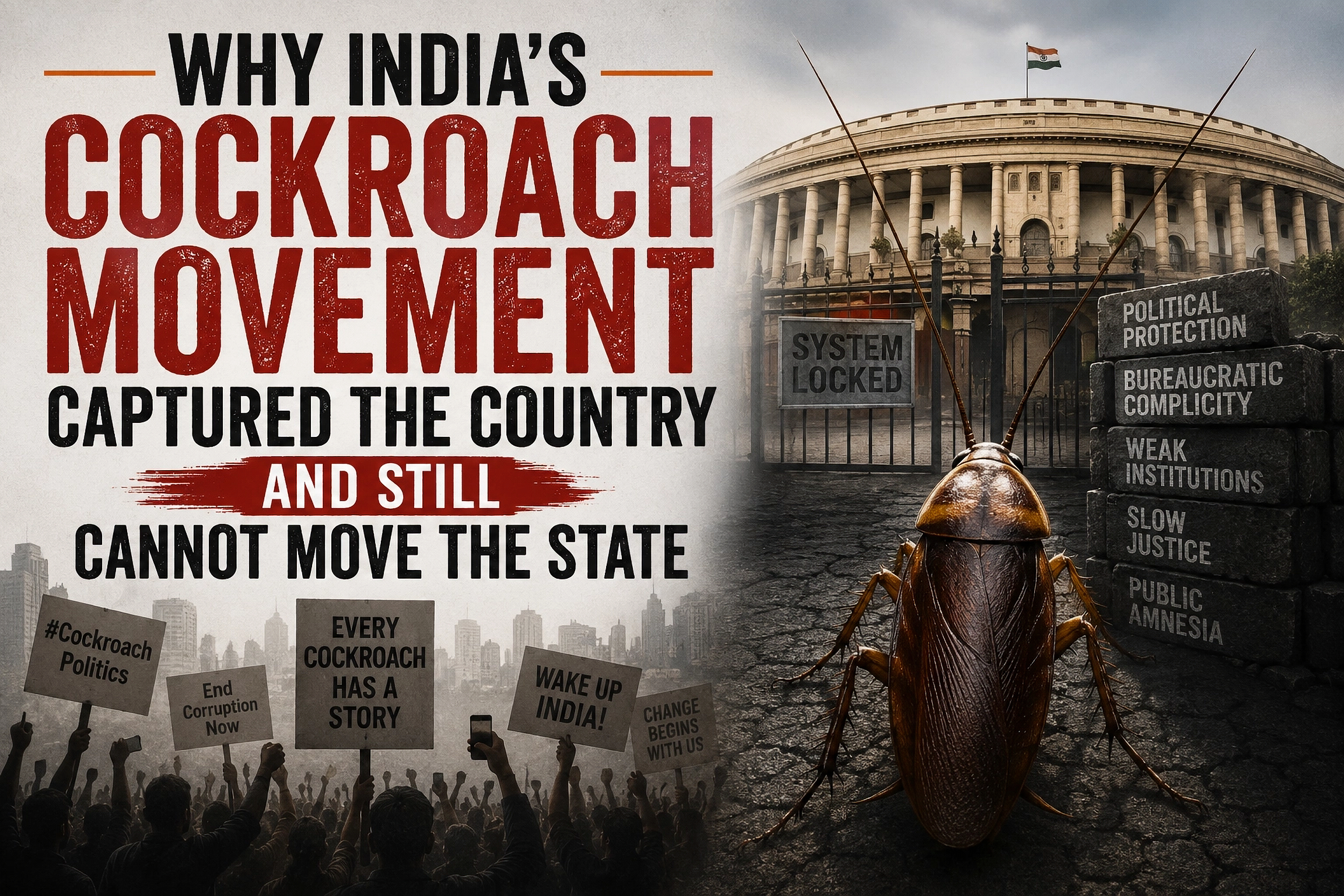
Five design errors anchor this analysis:
- A binary demand attached to a single individual. "The Minister must resign" is not divisible; there is no 40 per cent version of it. The state cannot partially concede without establishing that street mobilisation removes Union Ministers — a precedent no government with a working majority will grant, because the price is paid on every subsequent agitation.
- No transmission mechanism. Movements win by making inaction expensive in a currency the state spends: votes, revenue, or coalition stability. The CJP's constituency is geographically diffuse, disproportionately composed of first-time and unregistered voters, and economically non-disruptive. A permitted sit-in imposes no cost on any actor whose cooperation the government requires.
- Geographic and personal concentration. Holding one permitted site in the capital converts national sentiment into a fixed, countable, containable object — the configuration policing doctrine is designed for. The movement also carried a single founder-face and borrowed a single moral asset, and both failed in the same week.
- Escalation without a ratchet. Peak leverage was spent on 20 July and followed within twenty-four hours by a public announcement that no further marches would occur — an unambiguous signal that the movement's maximum had been observed, priced and found survivable.
- Refusal of the table without a substitute arena. Rejecting talks over venue and dismissing the fast-track-courts announcement outright concedes the "we offered, they refused" frame at no cost to the state, and forfeits the only forum in which partial wins become binding text.
Correcting the premise
"Failure" is the wrong diagnostic category and produces the wrong prescription. Distinguish four stages every movement must pass: acquisition (recruiting adherents), salience (forcing the issue onto the national agenda), conversion (extracting a binding institutional commitment), and institutionalisation (making that commitment survive the movement's own decay).
The CJP cleared the first two decisively. Its Instagram presence crossed three million followers within 78 hours of launch and ten million inside five days. It drew a Prime Ministerial announcement on examination integrity within roughly six weeks of its first street action, and produced simultaneous disruption inside the monsoon session alongside sustained international coverage. Very few Indian civic movements reach stage two at all.
It is stuck at stage three. That is a design failure, not a scale failure — and the distinction matters, because the instinctive response to stage-three failure is more people, more days and more emotion, all of which the movement has tried, and none of which addresses the binding constraint.
One assumption is stated explicitly: this analysis treats the objective as the stated one — accountability in the conduct of public examinations. If the actual objective is the construction of a durable youth political vehicle, the scorecard changes substantially and the movement is performing well. Movements unclear internally about which objective they pursue lose both.
Context and position
Origin. Founded on 16 May 2026 by Abhijeet Dipke, a political communications strategist formerly associated with the Aam Aadmi Party, in response to a remark by the Chief Justice of India the previous day likening unemployed youth to cockroaches. The movement's genius was to accept the insult and wear it — a stigma-reversal play executed faster and cleaner than most professional campaigns manage.
Demand. The resignation of the Union Education Minister over the 2026 NEET paper leak and CBSE on-screen marking irregularities, plus broader reform of public examination conduct.
Position as at 24 July 2026. The 20 July march on Parliament was met with tear gas and baton charges. Delhi Police reported approximately 180 injured, of whom 118 were security personnel and 60 protesters; the CJP puts protester injuries at 150. Seventy protesters were detained with legal action initiated. On 21 July the movement announced it would hold the Jantar Mantar site but stage no further marches, citing supporter safety. On 22 July opposition MPs led by Rahul Gandhi carried the demand into Parliament. On 23 July the Prime Minister announced measures on paper leaks including fast-track courts; the CJP dismissed these as inadequate and rejected an invitation to talks, demanding a neutral venue. Sonam Wangchuk's indefinite hunger strike, begun 28 June, ended in forced hospitalisation after roughly twenty days and a reported loss of 9.1 kg.
Why the comparison set matters
The 2020–21 farm law agitation won because its demand — repeal of three specific statutes — was severable from any individual, legally executable in a single parliamentary act, and backed by an electoral clock in Punjab and Uttar Pradesh. The farmers also held all three levers: a concentrated vote bank in states going to polls, physical control of highway and mandi chokepoints, and allied pressure inside the NDA.
The 2023 wrestlers' protest demanded action against a named individual, ran at Jantar Mantar for nearly five months, and secured a slow, partial and largely symbolic outcome. The CJP has replicated the wrestlers' architecture, not the farmers'.
A note on register. Satire is an extraordinary acquisition technology: it lowers the cost of joining, survives ridicule by construction, and is difficult to repress without absurdity. It is a poor negotiation technology. Answering a Prime Ministerial policy announcement with a four-word slogan and a meme maximises engagement and minimises the probability of being treated as a counterparty. The register that built the movement is the register that prevents it from closing.
Risks and second-order effects
Risk | Mechanism | Severity |
Attrition decay | Monsoon conditions, examination calendars and the absence of a next milestone erode the sit-in; the movement ends without an event | High |
Criminalisation of organisers | FIRs and detentions from 20 July convert leadership bandwidth into legal defence | High |
Partisan capture | Parliamentary adoption raises salience but forfeits the "no political colour" claim, allowing reframing as a party operation | Moderate–High |
Splinter radicalisation | A leadership that publicly renounces marches while the base wants escalation creates space for an uncontrolled faction; a single violent incident resets public sympathy | Moderate |
Institutional-legitimacy spillover | Contested accounts of the 20 July policing carry reputational cost for the state and for the judiciary whose remark triggered the movement | Moderate |
Precedent effect | If a ten-million-strong mobilisation extracts no binding commitment, the demonstrated return on civic organisation falls — with consequences well beyond this issue | Moderate |
Four pathways
Option | Description | Pros | Cons | Complexity |
A. Hold the line | Maintain the sit-in and the resignation demand unchanged | Preserves moral clarity; costs nothing to decide | Optimises within an unwinnable frame; ends in attrition | Low |
B. Pivot to a statutory standard and federalise | Replace the resignation headline with a legislated, verifiable examination-integrity standard; move to district chapters; target state governments across party lines | Divisible and therefore concedable; proves non-partisanship; multiplies pressure points | Reads as retreat if sequenced badly; requires drafting capacity the movement lacks | High |
C. Convert to an electoral vehicle | Register formally and contest the early-2027 state cycle | Creates the missing transmission mechanism | Forfeits civic legitimacy; enormous capital and cadre requirement; historically low first-cycle returns | Very high |
D. Suspend and re-time | Declare a phase close, bank the gains, relaunch on an electoral clock | Preserves the base; avoids a visible defeat | Movements that stand down rarely stand back up | Moderate |
What we would do
Adopt Option B as the primary track, retain the resignation demand as a consequence rather than a headline, and hold Option D as the contingency.
The single most important move is the reframing. The demand should not be "the Minister must go." It should be "here is the standard, here is the timeline, and failure to meet it triggers the Minister's departure." That flips the state's calculation: conceding no longer means surrendering to the street, it means signing up to a delivery obligation — something governments can do, and have done. It also converts the movement's asset from anger into text.
- The substantive ask. A statutory Examination Integrity Authority with independent leadership and fixed timelines; mandatory public disclosure of any suspected leak within 72 hours; a codified cancellation-and-retest protocol with defined compensation for affected candidates; an annual public integrity audit tabled in Parliament; and extension to state-conducted recruitment examinations, where leak incidence is endemic across governments of every party. The Public Examinations (Prevention of Unfair Means) Act, 2024 supplies the legislative peg; the ask is enforcement architecture, not new principle.
- Days 1–30 — reframe and de-risk. Publish a one-page charter with the statutory ask and a stated minimum acceptable outcome, with resignation as clause seven rather than the masthead. Appoint a five-person negotiating panel with published mandate limits, accept any dialogue offer at any venue, and publish the transcript — refusing venue is defensible, refusing dialogue is not. Distribute leadership through regional conveners, rotating spokespersons and a written succession protocol; end open-ended hunger strikes in favour of medically supervised relay fasts. Stand up a legal cell for the 20 July detainees and file RTI applications on leak incidence, cancellation records and disciplinary action across the last five examination cycles. Data is the movement's cheapest weapon and it has not used it.
- Days 31–60 — federalise and convert. Establish chapters in 700-plus districts with a single mandated activity: documenting local examination and recruitment irregularities. That moves the movement out of one containable enclosure and makes it structurally non-partisan by targeting state governments of all colours. Run voter-registration drives at every chapter and at the Delhi site — a movement of ten million followers with no verified electoral roll holds no currency, and this is the highest-return single action available. Convene an independent expert commission of retired examination administrators, psychometricians and education economists to publish a draft bill, so the movement arrives at the next table with text.
- Days 61–90 — institutionalise. Circulate a candidate pledge card for the early-2027 state assembly cycle, offered to every party without exception; that is the transmission mechanism. Publish the first Examination Integrity Index by state, with methodology open to challenge. Define an explicit escalation ladder with published trigger conditions, so that any future escalation reads as a designed ratchet rather than an emotional reaction.
- Governance. The principal internal risk is that the movement has no constitution, no financial disclosure and no decision rule. Publishing all three would cost a week and would pre-empt the two attacks most likely to be used against it.
The counter-view
Three arguments cut against this analysis, and honesty requires stating them.
First, the movement may have achieved more than the scoreboard shows. A Prime Ministerial announcement within six weeks of a first street action is fast by any historical standard, and announcements have a way of becoming administrative reality once made. Judging conversion at day sixty-nine may be premature.
Second, experienced organisers would argue that the maximalist demand is an anchor rather than a target — that abandoning it early forfeits negotiating room, and that movements which soften their headline ask before the state has moved typically get less, not more. This is a serious objection, and the sequencing above is designed to answer it: the standard is added before the resignation demand is de-emphasised, not after.
Third, it is possible that no design would have worked. With a parliamentary majority, no imminent national election and a policing apparatus that has absorbed larger mobilisations, absorption may dominate concession regardless of how elegantly the movement is constructed. If so, the honest lesson is not that the CJP played badly, but that the conversion channel from civic mobilisation to institutional response has narrowed — a finding about the system, not about the strategists.
Accounts of the 20 July events remain contested; police and movement casualty figures diverge materially, and no independent verification is currently available. That dispute is noted here rather than resolved.
What this episode actually tests
Strip away the memes and the demand, and this is a controlled experiment in a question that matters far beyond one ministry: what return does organised civic energy earn in India today?
If ten million adherents, a national news cycle, a parliamentary disruption and a hunger strike produce a procedural announcement and nothing binding, the rational young citizen draws a conclusion — and it is not a conclusion about examinations. The most consequential outcome of this movement will not be whether one Minister stays. It will be what the next ten million people learn about whether organising is worth the trouble.