The District Is Where the State Lives
- Pritiraj Brahma

- Jun 22
- 5 min read
Updated: Jun 24
India debates the Centre and the states endlessly, and ignores the one tier where almost all governance actually succeeds or fails. The district is starved of the very capacity it is asked to deliver with.
Ask where power sits in India and you will get a familiar answer: in Delhi, and in the state capitals. The Centre legislates and funds; the states administer and contest. Our entire political conversation runs along this axis — Union versus state, one party versus another, this capital versus that one. It is a real axis. It is also not where most of governance is decided.
Governance is decided in the district. It is the district that turns a scheme into a service, a budget line into a built road, an announcement into something a citizen can actually use. The Collector's office is where the abstractions of policy meet the concreteness of a place — and where, more often than we admit, they quietly fail to meet at all. I have spent enough of my working life in and around that office to state the case plainly: the district is where the state lives, and we have starved it of the capacity we ask it to deliver with.
The most overloaded office in India
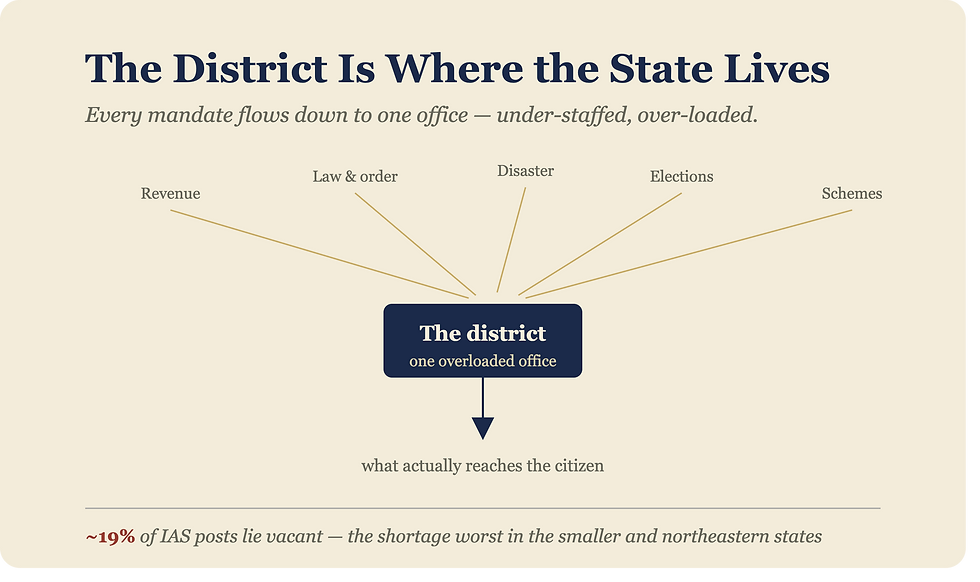
Consider what we actually ask of a District Collector. The role began, under colonial rule, as a revenue collector — a single, legible job. It has since accreted nearly everything else. Today the same officer is the district's chief revenue authority, its magistrate responsible for law and order, its disaster manager, its returning officer at elections, the implementing head for a long list of central and state development schemes, and the coordinator expected to harmonise the work of every line department — health, education, agriculture, public works, irrigation — operating in the district.
This is not a job; it is a dozen jobs worn by one person. The administrative literature has a dry phrase for what follows: the Collector has become "multi-dimensional," chairing dozens of committees in states such as Assam and Andhra Pradesh, indispensable precisely because everything routes through a single overburdened post. Former IAS officer T.R. Raghunandan has gone further, arguing that the system has built a "myth of the collector's infallibility" — concentrating administrative power in one officer in a way that is increasingly outdated and that crowds out the local governments meant to share the load. Whether or not one accepts his prescription, the diagnosis is hard to dispute: we have loaded the district's apex office past the point where careful work is possible, and then we express surprise when delivery is hurried, partial, or merely performed.
And it is short of the people to do it
An overloaded office might still function if it were fully staffed. It is not.
The Indian Administrative Service — the cadre from which Collectors are drawn — is running at roughly a 19 percent vacancy: about 5,577 officers in position against a sanctioned strength of 6,877, a figure disclosed in Parliament. Across the All India Services together, Parliament was told in early 2026 of some 2,834 vacant posts. And the shortage does not fall evenly. It concentrates, predictably, in exactly the places that can least absorb it — the smaller states and the Northeast, the remote and difficult postings that ambitious careers route around. Popular urban cadres fill; the hard districts wait.
The result is a compounding squeeze, and it is worth naming the mechanism because it is the heart of the matter. Responsibilities expand year after year as every new scheme adds a new mandate to the district. Capacity does not expand to match. So the same officers absorb more and more, until — in the words of one recent assessment of India's reform momentum — "policies multiply, but execution thins out," and governance "shifts toward compliance and reporting rather than problem-solving." A parliamentary committee put the consequence precisely: the shortage bites hardest at the field level, where timely decision-making and implementation are most critical. That is not an abstraction. The field level is the district. It is where the citizen actually stands.
Why the district is the real bottleneck?
It is tempting to treat this as a human-resources problem — fill the vacancies and move on. That is necessary but insufficient, because the deeper issue is structural, and it connects to a pattern I have written about before: India's persistent habit of investing enormously in the announcement of governance and almost nothing in the machinery of it.
Three failures compound at the district level:
We add mandates without adding capacity. Every new scheme is designed at the Centre or the state and handed down for the district to execute, as though execution were free. The mandate arrives with a budget and a target; it rarely arrives with the people, systems, or time to deliver it well. The district is treated as an infinitely elastic delivery arm rather than a finite institution with a breaking point.
We concentrate rather than distribute. Decades of constitutional reform — the 73rd and 74th amendments — were meant to push real authority down to elected local bodies and lighten the apex officer's load. The political will to actually do so has been thin. So power stays concentrated in the Collector, the panchayats and municipal bodies remain under-empowered, and the single overloaded office remains the single point of failure.
We measure the district by compliance, not outcomes. An overburdened administration, asked to report on everything, rationally retreats into the safe work of reporting and compliance — filing the return, ticking the box — rather than the harder, riskier work of actually solving a local problem. The system gets the behaviour it measures, and it measures motion.
None of these is solved by a slogan. They are solved by treating the district as the load-bearing institution it actually is — staffing it to its mandate, distributing its authority to the local bodies meant to share it, and judging it by what reaches the citizen rather than what is reported upward.
Govern from where the citizen stands
There is a tendency, in Indian public life, to believe that the important decisions are the ones taken on the largest stages — in Parliament, in the state assembly, in the press conference. Those decisions matter. But they are promissory notes, and the note is honoured or dishonoured in a district office that the national conversation never looks at. We have built a system that lavishes attention on the act of promising and neglects the institution that must keep the promise.
A nation is judged not by what it announces, but by what reaches its last home — and almost everything that reaches the last home passes through the district on its way. Strengthen that tier and a great deal of Indian governance quietly improves; neglect it, as we have, and no quantity of vision at the top will survive the journey down. If India is serious about delivery in its next decades, it will have to become serious about the district. That is where the state lives, and that is where it must be made to work.
Pritiraj Brahma is the founder of The Pritiraj Review and an IIM Bangalore Fellow. He led World Bank–funded state programmes in Meghalaya and authored a district development strategy adopted as government policy. He writes on governance, statecraft, and the craft of delivery.

Comments