The Last Mile Is the Whole Journey
- Pritiraj Brahma
- 9 hours ago
- 4 min read

Insights from 71 Pig Farms in the Garo Hills
By Pritiraj Brahma
The gap between what India announces and what reaches its people is where governance truly lives and dies. This essay explores that gap through a focused lens: the story of 71 pig farms in the Garo Hills. These farms reveal the challenges and opportunities in bridging policy intent with real-world outcomes, especially in skill development and rural livelihoods.

Traditional piggery farm in Meghalaya, where native skills meet local livelihoods
Indian Governance Confuses Announcement with Achievement
India’s governance often treats the announcement of a policy or program as the achievement itself. This confusion overlooks the critical space between intent and outcome. The real test of governance is not in the grand declarations but in what actually reaches the last home.
For example, central government schemes like the Mahatma Gandhi National Fellowship (MGNF) and various skill development initiatives are widely publicized. Yet, their impact on the ground remains uneven. The announcements create expectations, but the delivery mechanisms frequently falter. This gap is not accidental; it reflects systemic challenges in design, incentives, and administration.
The Pritiraj Review exists to examine this gap closely, to understand why good intentions often fail to translate into meaningful change. The story of piggery farms in the Garo Hills offers a concrete case study of this phenomenon.
The Skilling Paradox
Skill development programs in India often follow a centralised, standardised model. These programs design trades and curricula based on capital-intensive industries and urban markets. They assume a one-size-fits-all approach, ignoring the native talent and local economic realities of rural India.
This approach creates a paradox. On one hand, traditional skills rooted in local culture and environment are undervalued and unsupported. On the other, these native skills are not automatically ready for integration into modern markets or industries. The real challenge lies in bridging this divide at the last mile.
For instance, many rural communities have rich knowledge of animal husbandry, agriculture, and crafts. Yet, these skills remain disconnected from formal markets or value chains. Without adaptation and support, traditional skills cannot generate sustainable livelihoods.
The Pritiraj Review’s work in the Garo Hills shows how bridging this gap requires more than training. It demands contextual understanding, market linkage, and administrative support tailored to local conditions.
The Proof from the Garo Hills
Almost every household in the Garo Hills keeps pigs, a native skill passed down through generations. Despite this, Meghalaya imports approximately 18,000 tonnes of pork every year. The local supply and demand were never connected at scale.
Working with the district administration in Ampati, South West Garo Hills, I helped develop 71 functioning piggery farms. These farms combined native pig-rearing skills with market-oriented practices, creating a sustainable livelihood model.
This initiative involved:
Training farmers in improved breeding and health management
Establishing supply chains to connect local pork producers with urban markets
Collaborating with local government bodies to provide ongoing support
The result was a clear demonstration that native capability, when fitted to real market demand, can thrive. This success challenges the assumptions of centralised skill programs and highlights the importance of last-mile adaptation.
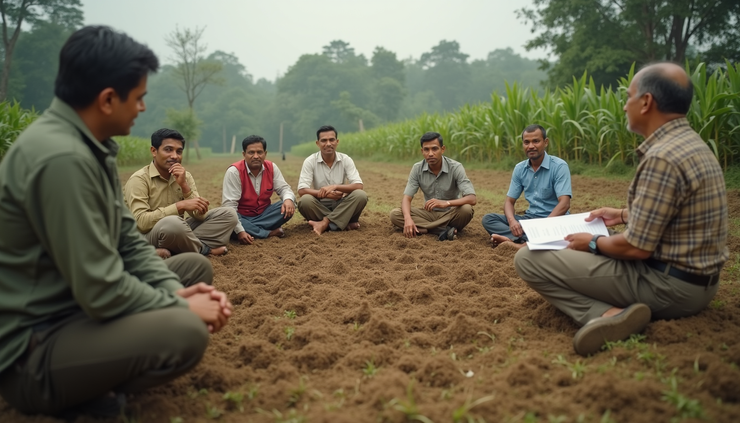
Training session at a piggery farm in Meghalaya, blending native skills with market knowledge
Four Reasons the Last Mile Fails Everywhere
The experience in the Garo Hills also reveals why last-mile delivery fails in many contexts:
Distance of Design
Policies are often designed far from the communities they aim to serve. This distance leads to solutions that do not fit local realities.
Misaligned Incentives
Administrators and implementers may focus on inputs or compliance rather than actual impact. This misalignment reduces motivation to solve last-mile problems.
Wrong Yardstick
Counting inputs like the number of trainings or funds disbursed ignores whether these efforts translate into improved livelihoods or services.
Last-Mile Administrative Vacuum
The final stage of implementation often lacks dedicated personnel or resources. This vacuum causes breakdowns in delivery and support.
Addressing these four challenges requires rethinking governance structures and evaluation metrics. The Pritiraj Review advocates for policies that prioritize outcomes at the last mile, supported by local knowledge and sustained engagement.
Bridging the Gap with Local Solutions
The piggery farm project in Meghalaya is a practical example of bridging the gap between policy and practice. It shows that:
Local skills can be enhanced, not replaced, by formal training
Market linkages must be built with an understanding of local demand and supply dynamics
Collaboration between communities and district administrations is essential
Monitoring should focus on impact, not just inputs
This approach aligns with the goals of the Mahatma Gandhi National Fellowship (MGNF) and other skill development programs but requires adaptation to local contexts.

Native pigs feeding in a piggery farm, illustrating the blend of tradition and improved practices
The Last Mile Is the Whole Journey
The journey from policy announcement to impact is not a straight line but a complex path filled with challenges. The last mile is not just the final step; it is the whole journey where governance is tested.
The Pritiraj Review aims to write in this gap, highlighting stories and lessons from the ground. The conviction is clear: a nation is judged not by what it announces, but by what reaches its last home.
For policymakers, institutions, and researchers, the lesson is to focus on the last mile with the same rigor as the announcement. Only then can skill development and rural livelihoods programs fulfill their promise.
Listen to what the District Magistrate says about me and my work:
This essay reflects my experience working closely with local communities, district administrations, and policy frameworks. The insights from the Garo Hills piggery farms offer a grounded perspective on the challenges and possibilities in Indian governance today.
The Pritiraj Review will continue to explore these gaps, providing evidence-based analysis to support better policy design and implementation.
Comments